Gracious reader,
Division is everywhere, and it’s easy to feel frustrated, overwhemed, powerless about what we can do to help.
But a recent experience caused me to wonder if one of the most powerful answers is far simpler, and far closer to home.
What if renewal begins with a front porch?
Or a dinner table?
Or a restaurant where the owner remembers your name?
A Simon in a world of Soup Nazis
We all know the Soup Nazi archetype from Seinfeld: the place where the product is so good that people tolerate being diminished and abused to get it. The joke works because it reveals something true. We have all encountered institutions where excellence becomes an excuse for contempt, where customers, patients, students, clients, or guests are treated as interruptions rather than human beings. The food may be extraordinary. The service may be efficient. The institution may be impressive. But the encounter leaves you feeling smaller. I had an experience recently that showed me
Last week, I was in Iowa to be the closing keynote at the Central Iowa Business Conference. It was a joy to be there and meet in person so many of the people I’ve come to know primarily virtually, includign those in Urbandale, Iowa. Urbandale is one community that has just announced The Soul of Civility as its community read, and leaders across Central Iowa—including those at St. Ambrose University and beyond—are beginning to ask what it might look like to take the ideas of the book off the page and into the life of their community.


After several days in Chicago with the Aspen Institute at their Social Trust Summit, I drove five hours to the Des Moines for the keynote. When I arrived, tired and hungry, I asked my hosts the most important question one can ask after a long drive: Where should I eat?
Their answer was immediate. You have to go to Simon’s.
Then they looked at the clock and reconsidered.
Actually, it’s probably too late. The line will be around the block. You’ll never get in.
Naturally, this made me want to go even more.
What fascinated me was not simply that Simon’s was popular. Lots of restaurants are popular. What fascinated me was the way people spoke about it.
They did not begin with the menu.
They did not begin with the cocktails.
They began with Simon.
He knows everyone.
He remembers your name.
He makes you feel like family.
One person told me that Simon makes strangers feel like friends, and friends feel like family.
So I called the restaurant.
To my surprise, Simon himself answered.
Then he immediately put me on hold—for several minutes.
Ordinarily, I might have found this annoying. But I found myself laughing, because while I waited, I could hear him doing the very thing everyone had described. He was greeting people as they walked in, saying goodbye as they left, checking on tables, laughing with guests, moving from one act of welcome to the next.
Even over the phone, I could tell that Simon was not simply running a restaurant.
He was creating belonging—the opposite of feeling like an imposition, as the Soup Nazi does, you feel like familty.

At Simon’s, excellence is not used as permission to disregard people. It becomes a reason to honor them. The food is good, yes. But the deeper gift is that Simon refuses to make people feel like nuisances in a place they came to enjoy. He makes the stranger feel received. He makes the regular feel remembered. He makes a crowded restaurant feel like a living room.
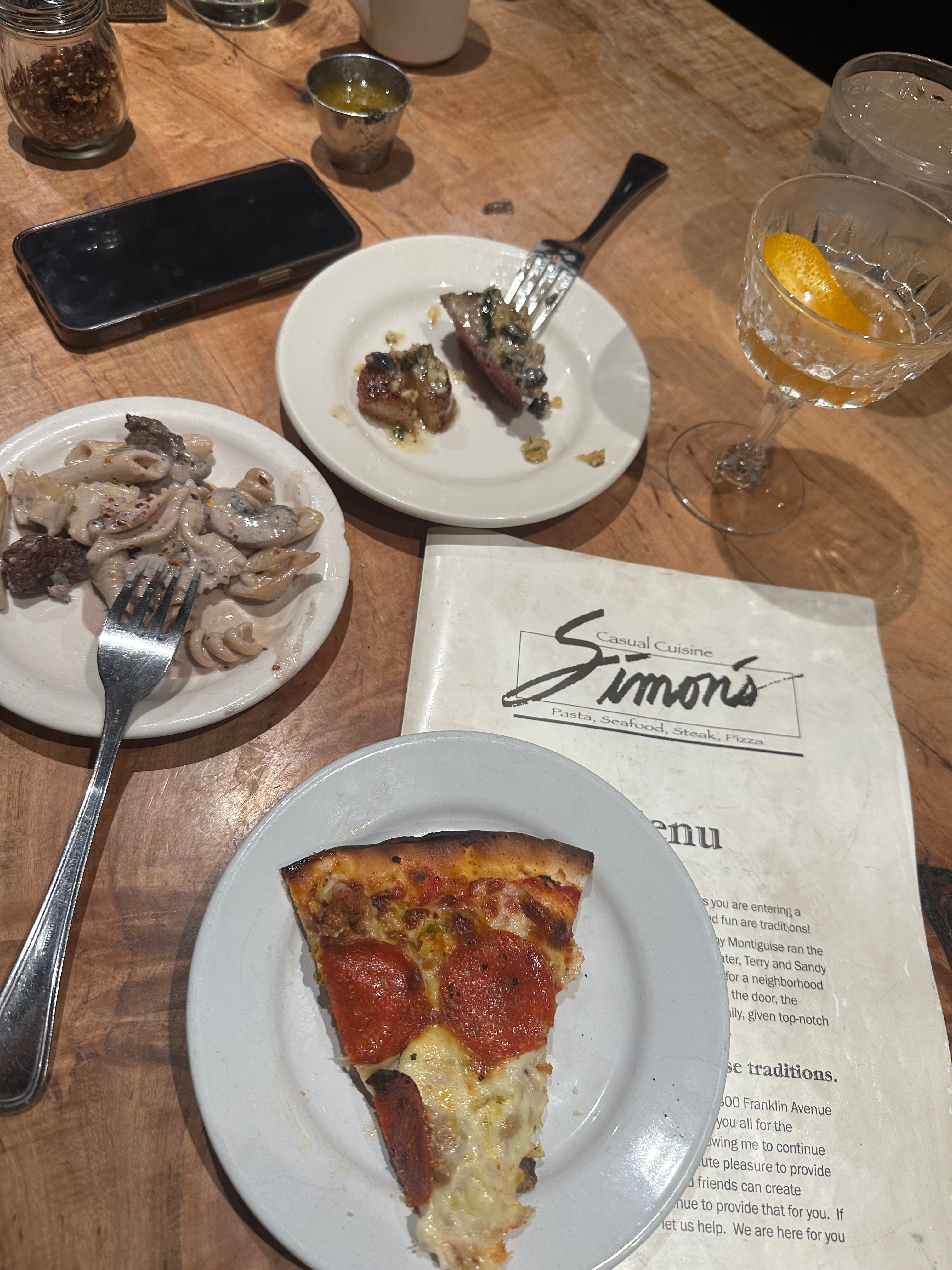
Later that evening, I found myself sitting at his bar.
Within minutes, complete strangers were passing dishes in my direction.
You have to try this.
No, try this one.
This is your first time here? Welcome.
His hospitality was contageous. It made his patrons hospitable, too.
Beauty begets beauty. Civility begets civiltiy. Warmth begets warmth. Hospitality begets hospitality.
I had already eaten dinner elsewhere, which made no difference at all. While everythign was delicious, the evening had stopped being about food. It had become about fellowship.

The people around me spoke about Simon with an affection I almost never hear people use about a restaurant owner.
One couple told me they had been coming for years.
The food originally drew them.
Simon keeps them coming back.
They told me stories that sounded almost unbelievable. On busy nights, when people have waited too long, Simon has been known to drive guests down the street and buy them dinner at another restaurant rather than leave them hungry.
From the standpoint of efficiency, this makes no sense.
From the standpoint of hospitality, it makes perfect sense.
Because Simon understands something many of us have forgotten.
People are hungry for more than food.
They are hungry to be seen.
They are hungry to be known.
They are hungry to matter.
The Latin word hospes gives us hospitality, hospital, hospice, host, and guest. I have always loved that host and guest share the same root, because embedded in the word itself is a beautiful and demanding idea: the stranger is not merely someone to tolerate or manage. The stranger is someone to welcome.
That is what Simon does.
And as I sat there, I realized I had seen this before.
Not in a restaurant.
On a porch.
Would you like to “porch” with us?
When I first moved from Washington, D.C., to Indianapolis, I was lonely. I did not yet know many people. Indianapolis did not yet feel like home.
Then one Sunday after church, a tall blonde woman named Joanna Taft introduced herself and asked me a question I had never heard before.
Would you like to porch with us sometime?
Porch, as a verb.
I was curious, and I said yes.
That afternoon changed the way I understood community.
On Joanna’s porch, people from different neighborhoods, professions, political beliefs, and walks of life gathered together, not for a structured dialogue, not to win an argument, not to perform unity, but simply to share life.
To talk.
To laugh.
To eat.
To be neighbors.
There was something almost subversive about it.
In a culture that so often trains us to encounter one another first as categories, Joanna had created a place where people encountered one another first as human beings.
Only later as Democrats or Republicans.
Only later as professionals or activists.
Only later as people who disagreed.
Joanna’s porch and Simon’s restaurant are different kinds of places.
One has cocktails and cake.
One has wicker chairs and neighborhood children running around.
But they do the same work.
They transform strangers into neighbors.
They remind people that they belong.
They create the conditions under which trust can grow.
And that matters because I do not think our deepest crisis is political.
I think it is relational.
We are living through a crisis of alienation, loneliness, and failing to see one another clearly, as beings with dignity and worth.
Much of the hostility around us is downstream from that.
People who feel unseen often struggle to see others.
People who feel disconnected often struggle to connect.
People who feel reduced to a label often learn to reduce others in return.
The antidote is not agreement.
The antidote is encounter.
Hospitality creates the possibility of encounter.
It gives us a place to meet one another not as abstractions, not as enemies, not as avatars of everything we fear, but as fellow human beings.
That is why hospitality is not peripheral to civic renewal.
It is central to it.
One of the great lessons of my work, especially after years of traveling to communities across North America and beyond, is that the people doing the work of renewal are rarely the people making national headlines.
They are people like Joanna.
They are people like Simon.
They are people who quietly create places where others feel welcome.
Places where strangers become friends.
Places where friends become family.
Places where people remember that they are not alone.
We cannot scale Simon.
There is only one Simon.
But we do not need to scale Simon.
We need more people to ask where they can become a Simon in their own life.
Where is your porch?
Where is your table?
Where is your garden?
Where is the place where you can make someone feel seen, known, and welcomed?
Every community has opportunities for hospitality.
Every one of us has more power than we realize.
The invitation matters.
The welcome matters.
The extra chair at the table matters.
Every act of hospitality pushes back against the forces pulling us apart.
Every gesture of welcome affirms the dignity of another person.
Every porch, every table, every restaurant, every gathering can become a small act of resistance against alienation.
In a world full of Soup Nazis, be a Simon.
Their hospitality, a high and noble expression of civility, will heal our broken world.
May 19: Aspen Institute Social Trust Summit. Chicago, IL
May 21: The Central Iowa Chamber of Commerce Business Conference, Altoona, IA
June 22-25: ARC Conference, London, UK: I’ll be speaking at the Alliance of Responsible Citizenship Conference this year, adding my voice to the global dialogue on rebuilding the habits of a healthy society. I hope to see you there!
In the news:
C-SPAN Washington Journal: Lexi Hudson Discusses Civility in American Politics
Alexandra Hudson discusses efforts to promote civility in American politics considering heated political rhetoric and its potential ties to acts of political violence.
Art Life Faith Podcast: The Soul of Civility with Alexandra Hudson
Welcome to the Art Life Faith podcast, and I’m your host, Roger Lowther. In this episode I had the privilege of having a conversation with Alexandra Hudson, or Lexi, the author of “The Soul of Civility: Timeless Principles to Heal Society and Ourselves.” A number of weeks ago, she was passing through Tokyo on vacation with her family when she was gracious enough to sit down with me and talk about the various themes in her book and then lead an Art Life Faith event right afterward.
Fox 21 News: Reclaiming Civility: Cultivating connection and respect in Colorado Springs
Fox 59: 11th annual Fairbanks Symposium- Watch here
A media interview about The Civic Renaissance Tour Launch in Indianapolis
A podcast interview with Michael Lee of the University of Charleston, When We Disagree Podcast: The Soul of Civility, Tested
What does civility demand when justice is costly and deeply personal? Alexandra Hudson, author of The Soul of Civility and founder of Civic Renaissance, shares a raw story about how being scammed sparked both a lengthy legal battle and a profound disagreement with her husband over whether to fight or walk away. Through that conflict, Hudson wrestles with whether civility means politeness or principled confrontation, and what it costs our families when moral crusades take over our lives. The episode explores civility not as courteousness or softness, but as disciplined respect for human dignity even when the stakes are high and the gloves stay firmly on.
Review of The Soul of Civility in Indiana Capital Chronicle: With all due respect
Hudson is not alone in her pursuit for civility. A recent surveyshared by the Ronald Reagan Presidential Foundation and Institute’s Center on Civility and Democracy reported that 72% of Americans want to see more civility in our nation’s politics. The same survey found that Americans are divided on their outlook for our nation’s future, split nearly in half over whether to be optimistic or pessimistic about our ability to come together.
Review of The Soul of civility in Bitterroot Star: Disagree better
Our community is full of independent people who don’t like being told what to think. That’s a strength. But independence only works if we can argue honestly without tearing each other apart in the process. This book doesn’t offer a program or a slogan. It offers a reminder of the habits that make self-government possible.
Year Ago on Civic Renaissance:
Thank you for being part of our Civic Renaissance community!