Gracious reader,
I was thrilled when Town & Country me to comment on a question they had been reflecting on: the meanness growing at all levels of American life.
In Town & Country’s new reported piece on why America seems to have become so mean, I got to share why “unoffendability”—the super power of the 21st century— offers a third way between the two extremes that define modern life: cruel hostility and suffocating politeness.
Why we are trapped between hostility and politeness
One of the tensions of modern life that I explore in The Soul of Civility, and in my recent interview with Town & Country, is that many people feel trapped between two extremes: hostility on one side, and suffocating politeness on the other.
Both cruelty and fake niceness can become dehumanizing. One attacks people openly. The other papers over difference or manipulates people into agreement while avoiding honesty, respect, truth, and genuine engagement.
Our culture increasingly teaches people to interpret discomfort, disagreement, awkwardness, and offense as existential threats.
What can we do?
First, we can and must choose civility, which I define as:
The art of human flourishing.
The bare minimum of respect we are owed, and owe to others, by virtue of our shared humanity.
More than mere politeness, civility demands that we respect others enough to tell hard truths, and respect ourselves enough to speak our mind and set boundaries.
Not how we treat those we like, those we agree with, and those who can do things for us in return, but how we treat the other, the stranger, the person we don’t like, the person we disagree with, the person we may never see again, and the person who can never repay us.
Second, we can choose to be unoffendable, the superpower of the 21st century.
Unoffendability
Unoffendability means reclaiming the power we each have to choose how we respond to another person’s meanness.
We cannot control others. We cannot control what they say, how they behave, whether they understand us fairly, or whether they treat us with the dignity we deserve. But we can control ourselves. We can decide what we will do with our hurt, our anger, our embarrassment, and our desire to retaliate.
Unoffendability is not weakness. It is not passivity. It is not pretending that cruelty does not hurt or that injustice does not matter. Far from it. Unoffendability is refusing to surrender our agency to the person who provokes us. It is choosing ownership over our emotions and responses instead of letting another person’s failure determine who we become in that moment.
When we are misunderstood, provoked, criticized, or dismissed, we do not have to collapse into cruelty or fragility. We can maintain perspective, humor, proportion, and self-command. We can tell the truth without contempt. We can defend ourselves without becoming small. We can refuse to let another person’s meanness make us mean.
The relationship between civility and unoffendability is this: both require a secure sense of our own worth and dignity as human beings. When we know our worth to the marrow, we do not have to yell, scream, posture, dominate, or humiliate others to prove our significance. We do not need constant validation, nor do we collapse every time we are criticized, misunderstood, or slighted.
Civility is the outward expression of that security; treating others with respect because we are grounded enough not to see every disagreement as a threat. Unoffendability is the inward posture that makes civility possible; the refusal to surrender our peace, self-command, or humanity every time another person behaves badly.
As I told Town & Country:
“Unoffendability is the superpower of the 21st century.”

Questions for you to consider:
Where were you unoffendable recently?
Where, looking back, did you miss an opportunity to be unoffendable and want to do better next time?
I’d love to hear from you.
Each of us has far more power to be part of the solution than we realize.
Let’s choose to be part of the solution.
Thanks for being here.
Looking ahead:
May 14: ICMA Local Government Reimagined Conference: Democracy and the Public Trust, Philadelphia, PA
May 19: Social Trust Summit. Chicago, IL
May 21: Central Iowa Business Conference, Altoona, IA
June 22-25: ARC Conference, London, UK: I’ll be speaking at the Alliance of Responsible Citizenship Conference this year, adding my voice to the global dialogue on rebuilding the habits of a healthy society. I hope to see you there!
In the news:
C-SPAN Washington Journal: Lexi Hudson Discusses Civility in American Politics
Alexandra Hudson discusses efforts to promote civility in American politics considering heated political rhetoric and its potential ties to acts of political violence.
Art Life Faith Podcast: The Soul of Civility with Alexandra Hudson
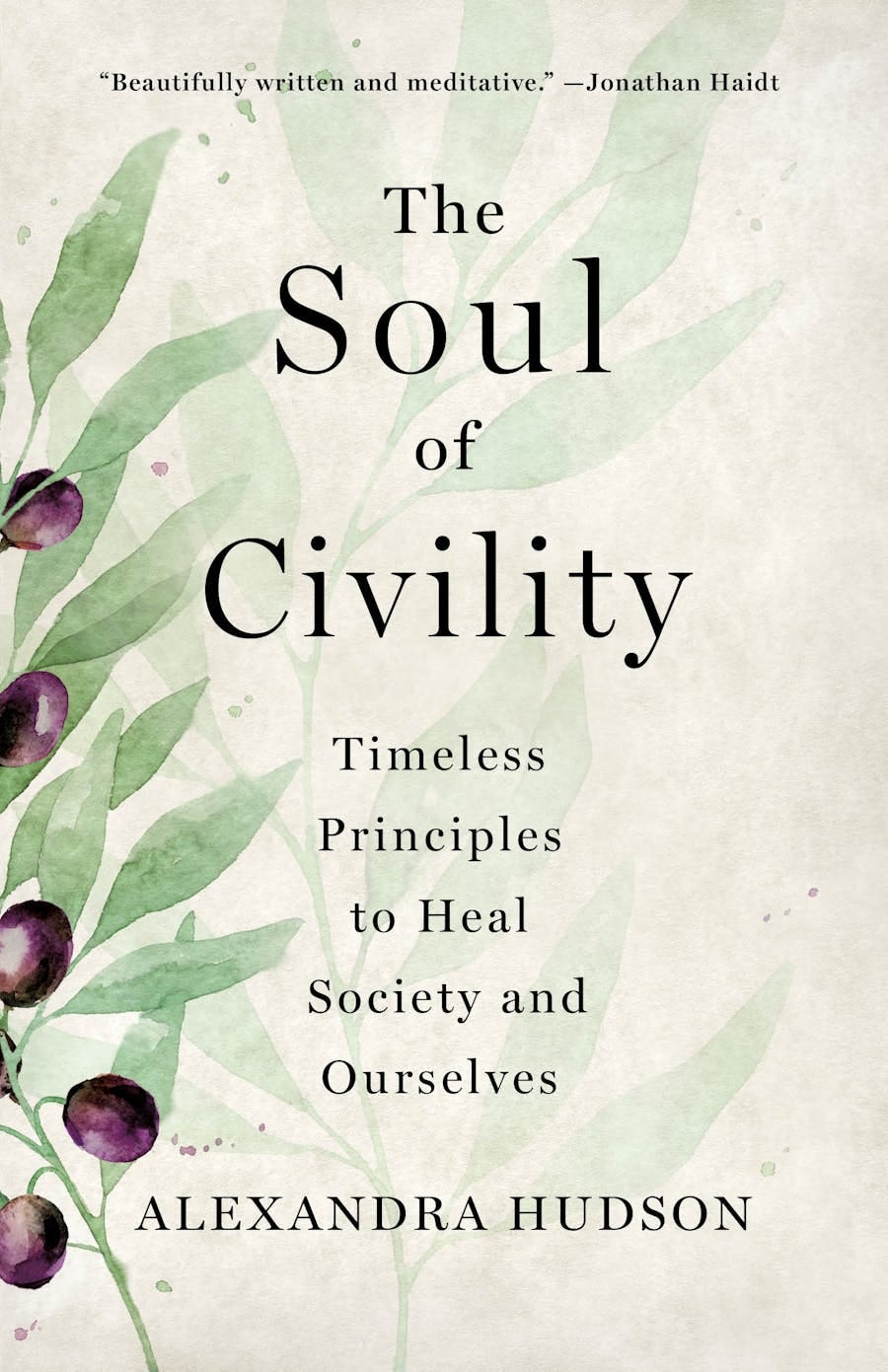
Welcome to the Art Life Faith podcast, and I’m your host, Roger Lowther. In this episode I had the privilege of having a conversation with Alexandra Hudson, or Lexi, the author of “The Soul of Civility: Timeless Principles to Heal Society and Ourselves.” A number of weeks ago, she was passing through Tokyo on vacation with her family when she was gracious enough to sit down with me and talk about the various themes in her book and then lead an Art Life Faith event right afterward.
Fox 21 News: Reclaiming Civility: Cultivating connection and respect in Colorado Springs
Fox 59: 11th annual Fairbanks Symposium- Watch here
A media interview about The Civic Renaissance Tour Launch in Indianapolis
A podcast interview with Michael Lee of the University of Charleston, When We Disagree Podcast: The Soul of Civility, Tested
What does civility demand when justice is costly and deeply personal? Alexandra Hudson, author of The Soul of Civility and founder of Civic Renaissance, shares a raw story about how being scammed sparked both a lengthy legal battle and a profound disagreement with her husband over whether to fight or walk away. Through that conflict, Hudson wrestles with whether civility means politeness or principled confrontation, and what it costs our families when moral crusades take over our lives. The episode explores civility not as courteousness or softness, but as disciplined respect for human dignity even when the stakes are high and the gloves stay firmly on.
Review of The Soul of Civility in Indiana Capital Chronicle: With all due respect
Hudson is not alone in her pursuit for civility. A recent surveyshared by the Ronald Reagan Presidential Foundation and Institute’s Center on Civility and Democracy reported that 72% of Americans want to see more civility in our nation’s politics. The same survey found that Americans are divided on their outlook for our nation’s future, split nearly in half over whether to be optimistic or pessimistic about our ability to come together.
Review of The Soul of civility in Bitterroot Star: Disagree better
Our community is full of independent people who don’t like being told what to think. That’s a strength. But independence only works if we can argue honestly without tearing each other apart in the process. This book doesn’t offer a program or a slogan. It offers a reminder of the habits that make self-government possible.
Year Ago on Civic Renaissance:
Thank you for being part of our Civic Renaissance community!