Gracious reader,
In honor of Martin Luther King Jr. Day, today I read to my children the story of Dr. King from a new collection of children’s stories I’m working on, Heroes and Villains: The Soul of Civility for Young Citizens—something I hope becomes a valuable home and classroom resource.
If you have young ones in your life, I’d love to invite you to share this video with them, or better yet, to read the story below aloud together. I wrote it around a core idea that was central to the work of Martin Luther King Jr.
Every single human being, without exception, is created with dignity and worth.
Because of that, we are all owed, and owe to others, a basic minimum of respect.
Segregation and cruelty do not only wound those who are excluded. They also deform those who exclude. Both are harmed. Both parties are dehumanized. As he wrote in his Letter from Birmingham Jail, written April 16, 1963, while imprisoned in Birmingham, Alabama, “Segregation distorts the soul and damages the personality. It gives the segregator a false sense of superiority, while it gives the segregated a false sense of inferiority.”
Civility, respect, graciousness, and kindness do not weaken us. They enlarge us. They elevate both the one who gives them and the one who receives them.
I’m still shaping this project, and I would genuinely welcome your feedback—both on this story and others. Please feel free to pass this along to a parent, educator, or administrator you care about, and if you’d like to offer feedback on more stories like this one, reach out to us at ahudsonassist@gmail.com
Happy Martin Luther King Jr. Day!
I’m grateful to be able to honor the life and legacy of this intellectual giant, and hero of civility, with you.
—
Now, what is the difference between the two? How does one determine whether a law is just or unjust? A just law is a man made code that squares with the moral law or the law of God. An unjust law is a code that is out of harmony with the moral law. To put it in the terms of St. Thomas Aquinas: An unjust law is a human law that is not rooted in eternal law and natural law. Any law that uplifts human personality is just. Any law that degrades human personality is unjust. All segregation statutes are unjust because segregation distorts the soul and damages the personality. It gives the segregator a false sense of superiority and the segregated a false sense of inferiority. Segregation, to use the terminology of the Jewish philosopher Martin Buber, substitutes an “I it” relationship for an “I thou” relationship and ends up relegating persons to the status of things.
—Martin Luther King Jr., Letter from Birmingham Jail
There are no gradations in the image of God. Every man from a treble white to a bass black is significant on God’s keyboard, precisely because everyone is made in the image of God.
—Dr. Martin Luther King, Jr.’s sermon “The Seeking God,” emphasizing that racial segregation is sinful because it devalues the imago dei—our divine reflection—in others, delivered in 1966
He who commits evil injures himself.
—Martin Luther King Jr, Strength to Love (1963)
Once upon a time, not so very long ago, and in a land very close to home, right here in our own country, there lived a boy named Martin Luther King Jr.
Martin grew up seeing two things at the same time.
He was taught, at home and at church, that every person is created in the image of God. That meant every person mattered, no matter what they looked like, where they came from, how much money they had, or what anyone else thought of them. It meant every person carried worth that could not be taken away. No rule, no sign, no opinion, and no law could erase it. And it meant something else, too. When people treated others as less than human, they were not only hurting the person in front of them. They were also forgetting something true about themselves, and harming their own hearts along the way.
And at the very same time, Martin saw a different lesson everywhere around him.
He saw signs and rules that treated some people as if they mattered less. He saw doors that were open to some and closed to others. He saw people told where they could sit, stand, drink, and learn, not because of what they did, but because of who they were.
This lesson had a name. It was called segregation.
Segregation taught people something false about the world. It taught some people that they were smaller than they were. It taught others that they were larger than they were.
Martin grew up holding both lessons in his mind at once.
The false one was loud and everywhere.
The true one was quieter, but deeper.
The more Martin saw people treated as less than human, the more tightly he held on to what he knew was true. That every person is a human being with equal dignity and worth, created in the image of God.
Martin’s world looked a little like ours. There were cars and buses, radios and electric lights, children walking to school and playing outside.
But his world also had rules and laws that asked people to forget the truth about what it means to be human: that every single one of us are equally valuable, beautiful, just the way we are.
When Martin was a boy, he went into a shoe store with his father. A clerk told them to move to the back so white customers could be helped first. They took a few steps.
Then Martin’s father stopped.
He did not shout. He did not argue. He decided they would leave instead.
They walked out together.
Martin felt embarrassed. But he also felt alert, as if a light had been turned on.
One person was taught, You do not belong.
Another was taught, Do not look too closely.
Both lessons were wrong.
Years later, in a city called Montgomery, a woman named Rosa Parks boarded a bus after a long day at work. She was told to give up her seat because she was Black.
She stayed seated.
She broke the law.
She was arrested.
Other passengers watched. Some felt relieved it was not them. Some stared out the window. Some pretended nothing was happening.
One person was taught, You do not belong.
Another was taught, Stay comfortable. Stay quiet.
Both lessons were wrong.
People decided they would no longer ride the buses. They walked instead. To work. To school. To the store. Day after day. This became the Montgomery Bus Boycott.
Martin, still young and unsure, was asked to help lead it.
The boycott lasted more than a year. It was tiring and hard.
One night, Martin’s house was bombed. A crowd gathered outside, angry and ready to hurt someone back. Martin stood in front of them and asked them to go home peacefully.
He knew that answering harm with harm would not heal anyone. It would only spread the damage.
Not long after, Martin was arrested again, this time in a city called Birmingham. He was put in jail for marching.
While he was there, a group of pastors wrote to him. They were not shouting at him. They were polite. They told him he was moving too fast. They told him he was making people uncomfortable. They told him that staying quiet would be wiser and kinder, and that time would fix things on its own.
In other words, they asked him to stay quiet and stay comfortable.
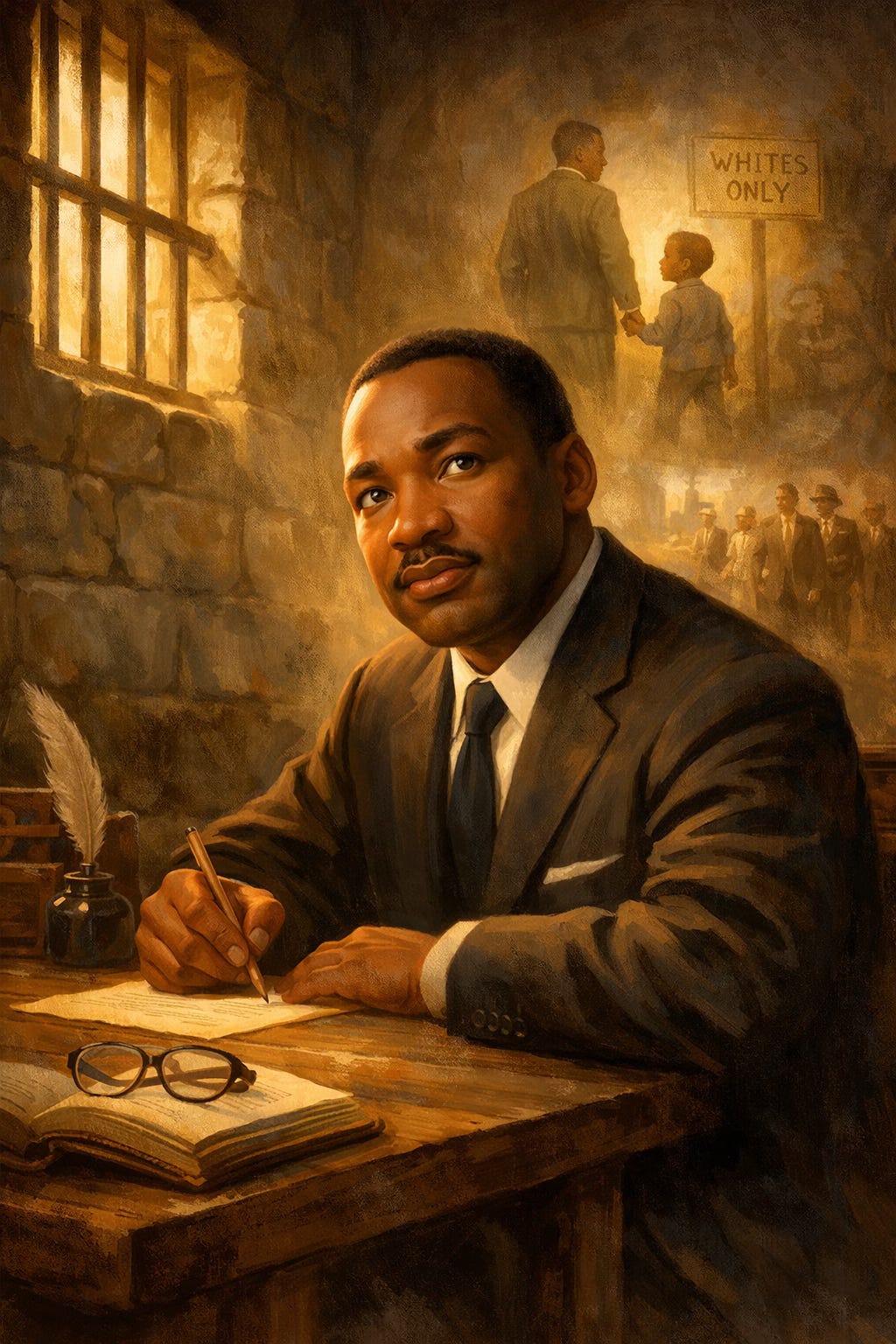
Martin read their words while sitting in a small jail cell. He had little paper, so he wrote back on scraps and margins.
He refused.
He knew that silence would not help people see the truth. Silence would help them keep believing something false.
He believed every person is a human being with equal dignity and worth, created in the image of God. And he believed that segregation did not only hurt the person pushed aside. It also hurt the person doing the pushing, and the person watching and looking away.
One person was trained to feel smaller than they were.
Another was trained to feel bigger than they were.
Both were taught something untrue.
Both were harmed by it.
Martin believed loving people meant helping them see the world as it really is. Not yelling at them. Not hurting them. But refusing to pretend that a lie was harmless.
Before marches, Martin trained people. They practiced staying seated while being shouted at. They practiced keeping their hands still when shoved. They practiced dignity the way you practice music or a sport.
During the marches, some people were pushed, insulted, and arrested. Others watched from sidewalks or windows.
One person was taught, You must endure cruelty.
Another was taught, Do not look too closely.
Both lessons were wrong.
Martin believed cruelty does not stop with the person it lands on. It changes the person who gives it and the person who allows it. It bends everyone involved.
He also believed the opposite was true.
When people choose care instead of cruelty, even when it costs them, they help others stand upright. And they help themselves remain whole.
Martin Luther King Jr. spent his life trying to help people see clearly.
He believed segregation hurts both the segregated and the segregator.
He believed silence protects false pictures of the world.
And he believed that telling the truth about who people really are is one of the most loving things a person can do.
One person was taught, You do not belong.
Another was taught, Do not look too closely.
Both lessons were wrong.
And Martin believed we could learn something better.
Because every day, in small moments and large ones, we are shaping one another.
And how we treat people shapes who we become, together.
Segregation, Martin Luther King Jr. taught, hurts both the person who is pushed aside and the person who does the pushing. Incivility works the same way. It harms everyone involved. But when people choose civility, when they act with care and kindness toward one another, both the giver and the receiver are made better
More on Martin Luther King Jr. from Civic Renaissance:
What MLK teaches us about civility and the power of ideas to heal our divides
What MLK teaches us about civility and the power of ideas to heal our divides
What is your life's blueprint? Dr. King and the Great Conversation
The Forgotten Virtue of Moderation
A live dialogue with Alexandra Hudson and Thomas Chatterton Williams
In an age shaped by outrage, certainty, and faction, moderation has become suspect. Those who refuse to sort neatly into camps are often dismissed as weak, naïve, or uncommitted. And yet, across history, the thinkers who most enlarged human understanding were rarely loyal to a side. They were loyal to truth.
This evening is a live dialogue between Alexandra Hudson and Thomas Chatterton Williams on the recovery of moderation as a serious intellectual posture, and on the examined life as its necessary foundation.
In the news
“Author launches national civic renaissance tour in Shelbyville,” The Shelbyville News
The Shelbyville effort is being led locally by Pastor Ralph Botte of First Christian Church of Shelbyville, who invited Hudson to help launch a community-wide initiative inspired by her book.
“When I read The Soul of Civility, it gave language to a problem I was seeing every day in Shelbyville,” Botte said. “People wanted to engage across differences without tearing relationships apart, but we didn’t have a shared framework for doing that. The book clarified what was missing: a way to practice civility that goes beyond surface politeness and is grounded in human dignity. That’s what led me to reach out to Alexandra. As we began sharing the book locally, people recognized themselves in it and wanted to take responsibility for living these ideas together.”
The Civic Renaissance Tour represents the next phase of Hudson’s work, building directly on the impact of The Soul of Civility. Since its release in 2023, the book has been taken up by community leaders, universities, and bipartisan legislative groups across the United States and abroad as a practical framework for engaging disagreement without dehumanization and for reclaiming responsibility at the local level. Rather than remaining a theoretical work, the book has repeatedly served as a catalyst for concrete civic initiatives. In an age marked by polarization and distrust, The Soul of Civility asks a central question: how can people flourish across difference?
Following the book’s publication, Hudson, often traveling with her husband and three small children, visited 136 cities across five countries. She spoke in venues ranging from local libraries and churches to Stanford University, Yale Law School, the Canadian Parliament, and the UK House of Lords. In city after city, the book sparked not only conversation, but sustained local action.
“The Civic Renaissance Tour grew out of listening,” Hudson said. “Everywhere I went, leaders were asking how to live these ideas together, not just talk about them. I realized my role was not to visit and lead every community, but to help local leaders build the capacity, relationships, and support they need to carry this work forward every day.”
The Shelbyville launch follows Hudson’s demonstrated framework for community renewal, a four-phase process that moves communities from shared understanding to sustained local practice. The effort begins with residents reading The Soul of Civility together, followed by Hudson’s visit for a public event and leaders’ roundtable. From there, local leaders across sectors will take responsibility for carrying the work forward in daily civic life, with the long-term goal of Shelbyville serving as a regional hub for civic renewal.
The Shelbyville engagement will begin with a community-wide public event on Thursday, January 29, at 7:00 p.m. at First Christian Church of Shelbyville. The following morning, Friday, January 30 at 9:00 a.m., Hudson and Botte will convene a leaders’ roundtable. During the roundtable, a select group of Shelbyville leaders will work together with Hudson to develop a practical action plan for implementing the book’s ideas and fostering long-term civic renewal in the community.
Hudson’s work with Shelbyville follows a demonstrated and repeatable pattern.
In Carmel, Indiana, City Councilor Jeff Worrell contacted Hudson after reading The Soul of Civility to explore how its ideas could be embedded locally. That effort culminated in the Carmel Civility Summit, which convened more than 100 mayors, city council members, commissioners, and civic leaders from 17 states and Canada. “The Soul of Civility was a roadmap that led me to invite Alexandra to speak and launch a civility effort in Carmel,” Worrell said. Former Indiana Governor Mitch Daniels and Hudson opened the summit with a fireside conversation on civility and leadership. “You’ve only begun to hear from this amazing young woman,” Daniels said.
In Zionsville, former Deputy Mayor Kate Swanson partnered with the Mayor’s Youth Advisory Council to integrate The Soul of Civility into the council’s core curriculum, grounding civic formation in a shared moral framework. The council then convened a public community discussion with Alexandra Hudson at the Hussey-Mayfield Memorial Public Library, drawing a standing-room-only audience and signaling broad public engagement across generations.
“Every person, and especially every young person, in America needs to read The Soul of Civility,” Swanson said.
In Muncie, The Soul of Civility was chosen as a citywide community read, anchoring a shared civic conversation across residents, institutions, and local leaders. State Rep. Elizabeth Rowray partnered with the Muncie Chamber of Commerce to invite Alexandra Hudson to keynote their Christmas banquet, where every attendee received a copy of the book as a call to carry the work into their own civic and professional lives.
Communities across Indiana, including Fishers, Valparaiso, South Bend, Evansville, New Albany, and Salem, are now implementing similar initiatives inspired by Hudson’s work.
Nationally, The Soul of Civility is informing freshman orientation programs at Ivy League universities and is being read in bipartisan book clubs within polarized state legislatures. The book has earned praise from leaders and public intellectuals across the political spectrum, including Francis Fukuyama and Jonathan Haidt.
The Civic Renaissance Tour formalizes this growing momentum by offering communities a structured pathway to move from shared ideas to sustained local practice. Additional tour stops include Colorado Springs, Colorado; Urbandale, Iowa; Sacramento, California; Austin, Texas; Pittsburgh, Pennsylvania; Toronto, Canada; and London, England, with more locations to be announced.
“My vision is to help unlock an era of human flourishing in our country,” Hudson, who lives in Indianapolis, said. “That work begins when people stop waiting for rescue and start taking responsibility for the communities they are shaping together. We each have way more power than we realize to be part of the solution.”
She continued, “Ralph, First Christian Church of Shelbyville, and the greater Shelbyville community are showing what that looks like in practice. I am honored to partner with the leaders of Shelbyville in this work.”
As the kickoff city of the Civic Renaissance initiative, Shelbyville is helping shape and refine a new model of community renewal rooted in Alexandra Hudson’s The Soul of Civility. The city is piloting the framework as it moves from idea to practice, generating lessons that other communities can adapt to their own contexts. By launching the Civic Renaissance Tour in Shelbyville, local leaders are contributing to an emerging national effort to strengthen civic life by investing in their own capacity to lead and flourish.
Become a Civic Renaissance Ambassador
To join the Civic Renaissance movement, or to bring the Civic Renaissance Tour to your community, apply to be a Civic Renaissance Ambassador!
Year Ago on Civic Renaissance:
It’s Time for a New Era of Christian Civility
Thank you for being part of our Civic Renaissance community!