Gracious reader,
My friend Ericka Andersen wrote a book, Freely Sober: Rethinking Alcohol Through the Lens of Faith, and has shared a guest post with us below that I hope you enjoy. Her book has me thinking about the role of alcohol in social life. (You might also enjoy learning more about Ericka’s work through her substack and podcast, Worth Your Time).
Note: Apologies again for the video cutting off. I recorded a full one, but Substack decided ten seconds was plenty. Expecting the best but prepared for the worst, I also recorded the audio, which you’ll find below.
Over the weekend, my husband sent me an article called Why My 2026 Resolution Is to Start Drinking Again. It has lingered with me. It was about social life, loneliness, and alcohol.
The author, a man in his mid-thirties, decided partway through the year to stop drinking. Not to recover from addiction, but as an experiment in health. He went fully sober and expected to feel better.
Instead, he found himself lonelier.
He wrote that drinking had quietly structured his social world. It was how he and his wife spent time together. It was how he stayed connected to friends. Dinners turned into evenings out, evenings out turned into conversations, and conversations turned into belonging. When alcohol disappeared, those rituals vanished with it. He tried to replace them. Exercise. New habits. New routines. But he found that rebuilding an entire social life in one’s thirties is harder than it sounds, especially when so much of friendship is organized around shared customs.
What struck me was not his conclusion. He eventually returned to drinking, saying that while sobriety made him physically healthier, he felt emotionally worse. What struck me was the question his story raised.
What do we do with the fact that alcohol has become such a central social glue in modern life?
Of course, alcohol can be abused. For many people it causes real harm. That reality matters and must be taken seriously. At the same time, alcohol has long played a role in human conviviality. Across cultures and centuries, people have fermented, brewed, and shared drinks as a way of marking time, celebrating, mourning, and gathering. Even the failure of Prohibition points to something real. You cannot simply remove a practice that carries deep social meaning without leaving a vacuum behind.
This is why I was grateful for the timing of a guest essay we are sharing this week from my friend Ericka Andersen, an Indianapolis-based writer who has just published her third book, Freely Sober.
Ericka writes honestly about alcohol not only as a substance, but as a coping mechanism. For many women, especially those juggling work, children, and constant pressure, drinking becomes a way to take the edge off a life that rarely slows down. Her reflections are not abstract. She shares her own story of dependence and of learning to rebuild both her interior life and her public life without alcohol at the center.
What I appreciate most in her writing is the refusal to treat the personal and the civic as separate realms. How we soothe ourselves privately shapes how we show up publicly. Loneliness, stress, and quiet despair do not stay neatly contained. They spill outward, into our relationships, our communities, and our civic life.
So I want to open this up to you.
Why do you think the author of that article found sobriety so socially isolating?
What rituals have quietly disappeared from our common life, and what has taken their place, if anything?
If alcohol is doing more relational work than we want to admit, what does that tell us about the fragility of our social bonds?
And how do we learn to see one another more clearly, not just the polished exterior, but the inner life behind it?
As Kafka said, “He who has eyes for beauty never grows old.” One of my hopes for Civic Renaissance is that this community sharpens our vision for beauty, that we learn to notice what sits beneath the surface and to respond with attention rather than indifference.
I would love to hear your thoughts on the article mentioned above, and Ericka’s thoughtful reflection about alcoholism and civic health below.
Thank you for being here!
Warmly,
Lexi
What Personal Sobriety Communicates About Flourishing Together
By Ericka Andersen
* Ericka is the author of the newly released book, Freely Sober: Rethinking Alcohol Through the Lens of Faith (InterVarsity Press)

Modern civic life often treats the personal and the public as separate realms: our inner struggles kept secret, and our shared responsibilities out in the open. But older traditions understood what we have largely forgotten: the health of a society depends on the inner and outer of its people.
We do not become good citizens exclusively by holding the “right” views or participating in public life. We do so by intentionally cultivating virtuous habits, like honesty, restraint, attention, and care in every aspect of our lives.
For many, including myself, sobriety is one such practice. This may not be necessary for everyone, but I’d like to discuss why it’s been an empowering tool fo me.
Sobriety is usually framed as a private health choice or a personal struggle. But, for some people, sobriety can be the right step toward building a deeper connection between their own healing and the common good at large.
The Recovery of Attention
Alcohol is not merely a substance or something we enjoy. For many, it becomes a socially sanctioned escape, numbing discomfort, quieting conflict, and subtly eroding our awareness of the people and responsibilities before us.
Choosing sobriety – even temporarily – interrupts this pattern and forces a return to attention.
Attention to one’s interior life rather than numbing it.
Attention to relationships rather than smoothing over tension.
Attention to truth rather than managing appearances.
This attentiveness is the groundwork of responsibility. A person who can remain present to discomfort without fleeing it is better equipped to listen well, to disagree without contempt, and to act with restraint rather than impulse. Such capacities are essential to civic life.
Temperance Reconsidered
Temperance is often misunderstood as repression or moral severity. In the classical and Christian traditions, it can mean something far richer: the ordering of desire and moderation toward what is good.
Sobriety is not merely abstention. Rather, we can use it as a tool, like an education of desire in some sense. We can learn what we reach for, why we reach for it, and what actually satisfies. This process reshapes not only private habits but ultimately, reflects out how we outwardly live our lives as well.
A temperate person is less governed by excess; of consumption, outrage, or appetite. They are less dependent on constant stimulation and more capable of patience, proportion, and mercy.
It’s not to say sobriety from alcohol is necessary for these goods to appear, but it’s something to consider & strive toward in all things we do.
Community as the Bridge Between Healing and the Public Good
Another essential truth about sobriety is that it is rarely sustained in isolation, but through shared practices of accountability and care.
It depends on the community, one that values truth-telling, accountability, shared practices, and mutual care. The benefits of these practices multiply internally and externally in how we move about the world.
When people learn to tell the truth about themselves, they become less invested in caricatures of others. When they learn to ask for help, they grow more willing to offer it. When they experience grace personally, they become less eager to weaponize judgment publicly.
As someone who has attended many AA-style recovery meetings, I can attest that this is true. We learn a person’s wholeness when we allow the truth of their struggle to ring free. Partisan angles disappear when we can see and communicate with one another as broken but beautiful image bearers of God.
In this way, sobriety strengthens the social fabric – not through programs or slogans, but through restored relationships and renewed moral imagination.
Flourishing Is Never Merely Individual
Modern culture often defines flourishing in solitary terms: autonomy, happiness, self-expression. But human flourishing has always been communal. We flourish when our freedoms are shaped by love rather than impulse, and when our lives are ordered toward God and neighbor.
Sobriety is one path, among many, by which some people rediscover this truth. Those who have struggled with addiction and come on the other side have some of the most profound insights about life. A favorite author of mine, Laura McKowen, titled her sobriety memoir, We Are the Luckiest. She did so because she claimed the hard-won wisdom and insights she had gained in her struggle – information and empowerment she would never have received otherwise.
To cheer for the healing of others and embrace an environment where that is more possible is to cultivate a more beautiful world. Some of the most durable forms of cultural renewal often begin quietly, in lives remade from the inside out.
The restoration of civic life will not come solely from better policies or sharper arguments, necessary as those are. It will take more than that – individual lives transformed, personal decisions made that lead us toward betterment and virtue for ourselves and the common good.
These themes are explored more fully in my book, Freely Sober: Rethinking Alcohol Through the Lens of Faith. There, I examine sobriety not as self-denial, but as a practice of truth, freedom, and renewed belonging.
In the news
“Author launches national civic renaissance tour in Shelbyville,” The Shelbyville News
The Shelbyville effort is being led locally by Pastor Ralph Botte of First Christian Church of Shelbyville, who invited Hudson to help launch a community-wide initiative inspired by her book.
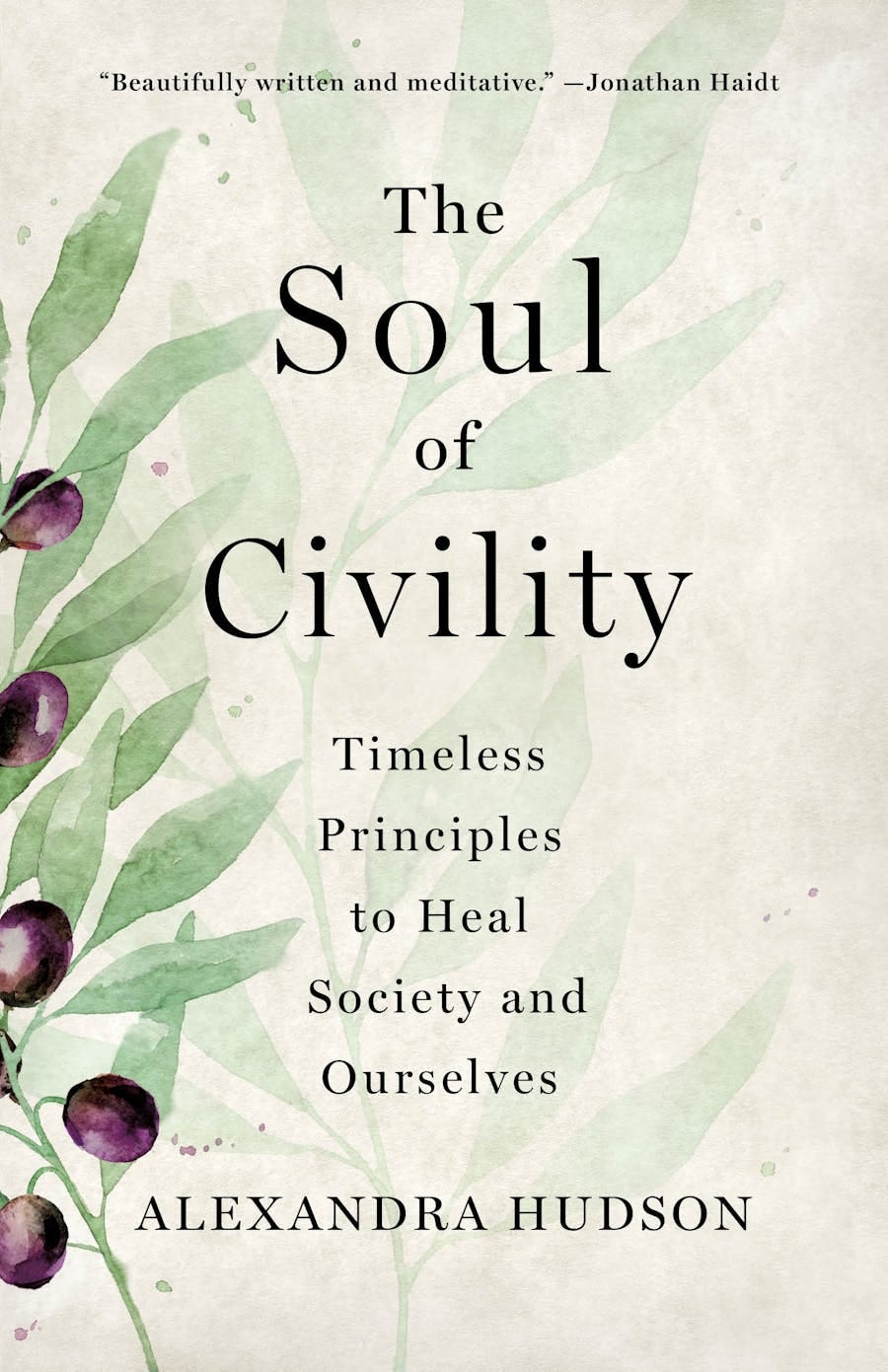
“When I read The Soul of Civility, it gave language to a problem I was seeing every day in Shelbyville,” Botte said. “People wanted to engage across differences without tearing relationships apart, but we didn’t have a shared framework for doing that. The book clarified what was missing: a way to practice civility that goes beyond surface politeness and is grounded in human dignity. That’s what led me to reach out to Alexandra. As we began sharing the book locally, people recognized themselves in it and wanted to take responsibility for living these ideas together.”
The Civic Renaissance Tour represents the next phase of Hudson’s work, building directly on the impact of The Soul of Civility. Since its release in 2023, the book has been taken up by community leaders, universities, and bipartisan legislative groups across the United States and abroad as a practical framework for engaging disagreement without dehumanization and for reclaiming responsibility at the local level. Rather than remaining a theoretical work, the book has repeatedly served as a catalyst for concrete civic initiatives. In an age marked by polarization and distrust, The Soul of Civility asks a central question: how can people flourish across difference?
Following the book’s publication, Hudson, often traveling with her husband and three small children, visited 136 cities across five countries. She spoke in venues ranging from local libraries and churches to Stanford University, Yale Law School, the Canadian Parliament, and the UK House of Lords. In city after city, the book sparked not only conversation, but sustained local action.
“The Civic Renaissance Tour grew out of listening,” Hudson said. “Everywhere I went, leaders were asking how to live these ideas together, not just talk about them. I realized my role was not to visit and lead every community, but to help local leaders build the capacity, relationships, and support they need to carry this work forward every day.”
The Shelbyville launch follows Hudson’s demonstrated framework for community renewal, a four-phase process that moves communities from shared understanding to sustained local practice. The effort begins with residents reading The Soul of Civility together, followed by Hudson’s visit for a public event and leaders’ roundtable. From there, local leaders across sectors will take responsibility for carrying the work forward in daily civic life, with the long-term goal of Shelbyville serving as a regional hub for civic renewal.
The Shelbyville engagement will begin with a community-wide public event on Thursday, January 29, at 7:00 p.m. at First Christian Church of Shelbyville. The following morning, Friday, January 30 at 9:00 a.m., Hudson and Botte will convene a leaders’ roundtable. During the roundtable, a select group of Shelbyville leaders will work together with Hudson to develop a practical action plan for implementing the book’s ideas and fostering long-term civic renewal in the community.
Hudson’s work with Shelbyville follows a demonstrated and repeatable pattern.
In Carmel, Indiana, City Councilor Jeff Worrell contacted Hudson after reading The Soul of Civility to explore how its ideas could be embedded locally. That effort culminated in the Carmel Civility Summit, which convened more than 100 mayors, city council members, commissioners, and civic leaders from 17 states and Canada. “The Soul of Civility was a roadmap that led me to invite Alexandra to speak and launch a civility effort in Carmel,” Worrell said. Former Indiana Governor Mitch Daniels and Hudson opened the summit with a fireside conversation on civility and leadership. “You’ve only begun to hear from this amazing young woman,” Daniels said.
In Zionsville, former Deputy Mayor Kate Swanson partnered with the Mayor’s Youth Advisory Council to integrate The Soul of Civility into the council’s core curriculum, grounding civic formation in a shared moral framework. The council then convened a public community discussion with Alexandra Hudson at the Hussey-Mayfield Memorial Public Library, drawing a standing-room-only audience and signaling broad public engagement across generations.
“Every person, and especially every young person, in America needs to read The Soul of Civility,” Swanson said.
In Muncie, The Soul of Civility was chosen as a citywide community read, anchoring a shared civic conversation across residents, institutions, and local leaders. State Rep. Elizabeth Rowray partnered with the Muncie Chamber of Commerce to invite Alexandra Hudson to keynote their Christmas banquet, where every attendee received a copy of the book as a call to carry the work into their own civic and professional lives.
Communities across Indiana, including Fishers, Valparaiso, South Bend, Evansville, New Albany, and Salem, are now implementing similar initiatives inspired by Hudson’s work.
Nationally, The Soul of Civility is informing freshman orientation programs at Ivy League universities and is being read in bipartisan book clubs within polarized state legislatures. The book has earned praise from leaders and public intellectuals across the political spectrum, including Francis Fukuyama and Jonathan Haidt.
The Civic Renaissance Tour formalizes this growing momentum by offering communities a structured pathway to move from shared ideas to sustained local practice. Additional tour stops include Colorado Springs, Colorado; Urbandale, Iowa; Sacramento, California; Austin, Texas; Pittsburgh, Pennsylvania; Toronto, Canada; and London, England, with more locations to be announced.
“My vision is to help unlock an era of human flourishing in our country,” Hudson, who lives in Indianapolis, said. “That work begins when people stop waiting for rescue and start taking responsibility for the communities they are shaping together. We each have way more power than we realize to be part of the solution.”
She continued, “Ralph, First Christian Church of Shelbyville, and the greater Shelbyville community are showing what that looks like in practice. I am honored to partner with the leaders of Shelbyville in this work.”
As the kickoff city of the Civic Renaissance initiative, Shelbyville is helping shape and refine a new model of community renewal rooted in Alexandra Hudson’s The Soul of Civility. The city is piloting the framework as it moves from idea to practice, generating lessons that other communities can adapt to their own contexts. By launching the Civic Renaissance Tour in Shelbyville, local leaders are contributing to an emerging national effort to strengthen civic life by investing in their own capacity to lead and flourish.
To join the Civic Renaissance movement, or to bring the Civic Renaissance Tour to your community, apply to be a Civic Renaissance Ambassador!
In case you missed it: Alexandra Hudson and Mitch Daniels at the Civility Summit
Year Ago on Civic Renaissance:
It’s Time for a New Era of Christian Civility
Thank you for being part of our Civic Renaissance community!