“Do not be fooled by our politeness. Our bows, our maze of rituals. Beneath it all... we could be a great distance away. Safe. And alone.”
Gracious reader,
This line from Lady Mariko, a protagonist in the 2024 Hulu series about the Japanese Shogunate, Shōgun, has been echoing in my mind as we pack for Japan.
In case you’re new here: My name is Alexandra Hudson. I am the author of The Soul of Civility: Timeless Principles to Heal Society and Ourselves. Civic Renaissance is my public humanities project and intellectual community dedicated to reviving the wisdom of the past to help us lead better lives here and now. We are animated by one question: How do we flourish across deep difference?
Japan is widely regarded as one of the most polite societies in the world. It is coherent, ordered, attentive, beautiful. That makes it a fascinating place to test the core distinction at the heart of my work: the essential difference between civility and politeness.
Politeness is technique. Manners. Etiquette. Surface harmony. It comes from polire, to polish or smooth.
Civility is an inner disposition of the heart rooted in recognizing the inherent dignity of others. It comes from civitas, the root of citizen, city, civilization. Civility is the duty of citizens who must live and disagree together.
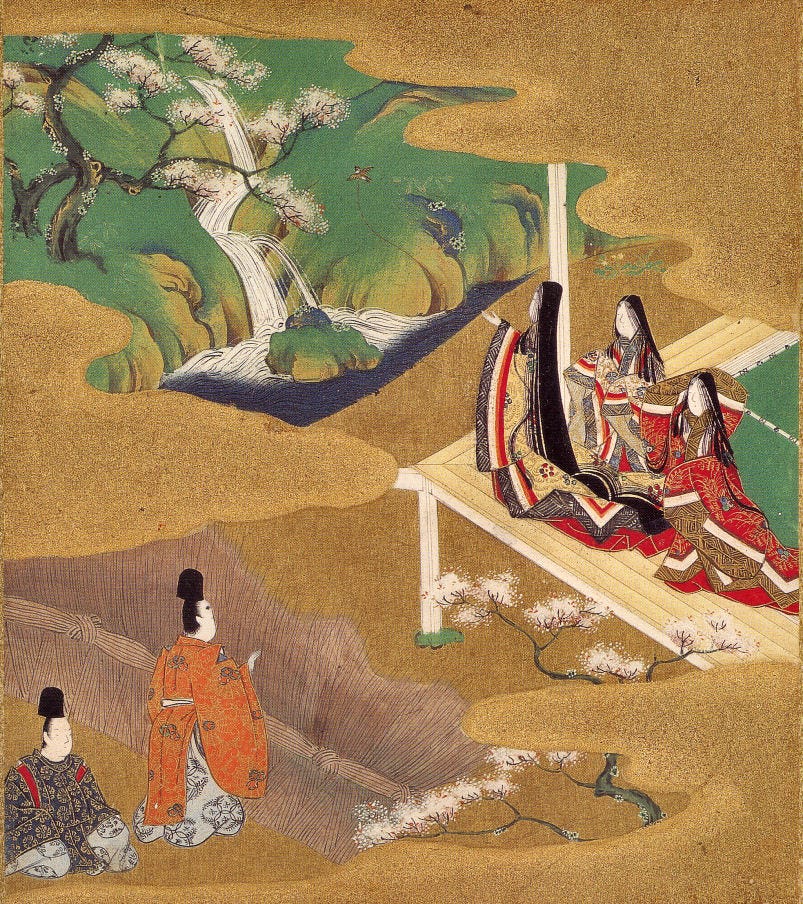
As we prepare for this trip, reading The Tale of Genji with the children and immersing ourselves in Japanese film and history, I am carrying four working hypotheses with me. They are provisional. They are drawn in part from dramatized history and early reading. I expect them to be refined, complicated, perhaps overturned. But they are honest starting points.
First: Outer politeness can conceal true feelings.
In Shōgun, Lady Mariko tells John, an English outsider, not to mistake bows and rituals for intimacy. Beneath them, she says, one may still be alone. She calles this the “Eightfold Fence,” a metaphor for emotional and social restraint.
She explains that in Japan, people build an “eightfold fence” around their hearts. The idea is that a person can perform perfect composure, loyalty, and politeness on the outside, while their inner thoughts and feelings remain sealed off behind multiple layers.
It is not a literal fence. It is a cultural metaphor. This concept is not a recognized historical concept, philosophical school, or codified element of Japanese social theory.
But this notion that there can be a disconnect between our outer conduct and inner feelings is an observation is not uniquely Japanese. It is human. A society can perfect the form of respect while neglecting the inner orientation that gives it meaning. One can perform deference while inwardly resenting. One can execute ritual flawlessly while feeling nothing at all.
There is another cultural echo of the distinction between civility and politeness. In Confucian philosophy, Confucius distinguishes between Li—manners, ritual, and propriety— and Ren—often rendered as common humanity.
Li refers to ritual and propriety, the outward forms that structure relationships and preserve social order. Ren refers to common humanity, the inner disposition of humane regard toward others. Ideally, li is meant to express and cultivate ren. Right action can, after all, re-enforce right belief and feeling.
Correct form can and sould should train the heart. But this tradition itself recognizes the danger that ritual can become hollow. One can perform the rite and miss the person. Confucian thought shaped Chinese civilization and, through centuries of cultural transmission, profoundly influenced Japanese political and social norms, especially around hierarchy, harmony, and role-based duty.
What interests me is the fault line between outer correctness and inner recognition. When propriety is severed from humane regard, the bow remains, but the bond does not. That disconnect between form and inner truth is the tension my work seeks to name.
We do this in the West as well. We smile at neighbors we quietly despise. We say yes to our boss, politely, through gritted teeth. We send carefully worded, pleasant emails while nursing contempt. We confuse the appearance of harmony with the presence of it.
Civility asks more. It asks not only that I say the correct words, but that I see you as a person whose dignity does not depend on my agreement.
Second: Rule-following is not the same as moral responsibility.
In one vignette, a gardener removes a rotting pheasant that has been left hanging outside a home. The stench is unbearable. He knows he is technically disobeying an order. He does it anyway for the good of the household. He is executed.
John, the Englishman, is horrified. He meant the spirit of the command, not blind compliance. He is stunned that obedience to hierarchy outweighs discernment about what is humane.
It is easy to treat this as dramatized, medieval excess. But the underlying question is perennial. When does fidelity to rules eclipse responsibility to persons? When does hierarchy replace judgment?
Civility, as I define it, requires moral agency. It requires that we do not hide behind structure or authority to avoid thinking. Respect for persons cannot be eclipsed by procedural compliance. (For more about this idea from a different cultural context, see Hannah Arendt on the Banality of Evil.)
Third: Social order can silence necessary dissent.
Early in the series, a samurai speaks out of turn in a council meeting. The punishment is ritual suicide. His infant son is also killed, because the father’s impropriety stains the family line.
The scene is harrowing. It dramatizes a culture in which preserving order outweighs preserving life. The town grieves, yet still insists that the penalty was required. The rule was broken. Therefore, death.
Again, this is historical drama. Still, it raises a live question. In any highly ordered society, what happens to dissent? What happens to the person who challenges authority without formal permission?
Democracy depends on disagreement. Disagreement is not a glitch in the system; it is evidence that citizens are thinking. But disagreement must be anchored in recognition of equal dignity, or it devolves into dehumanization.
If a culture overvalues politeness and ritual harmony, it may struggle to surface injustice. If it overvalues bluntness and individual assertion, it may fracture into contempt.
Which brings me to the fourth hypothesis.
Every culture has blind spots, including ours.
If Japan risks elevating form over interiority, the West often risks the opposite. We valorize disruption. We reward outrage. We confuse cruelty with candor. Social media incentivizes public shaming more than patient argument. Political discourse frequently slides from disagreement into character assassination.
Our problem is not that we are too polite. It is that we often disagree in ways that deny the humanity of those across from us.
Politeness without inner regard becomes hollow.
Candor without respect becomes corrosive.
Civility is neither avoidance nor aggression. It is an inner disposition that recognizes equal dignity, and then expresses that recognition through speech and action. It means I respect you enough to tell the truth as I see it. It means I respect myself enough to speak, and you enough not to patronize you by pretending we have no differences.
That is the experiment I am bringing with me to Japan. Not as a critic, but as a student. I want to visit schools. Observe classrooms. Learn about sake from those who craft it. Watch how table manners encode meaning. Notice how hierarchy functions in practice. Pay attention to when disagreement is voiced and when it is deferred.
If you know individuals or institutions in Japan who would want to explore these questions with us, reply and introduce us. I am eager to listen.
I am going for myself. I am also going for you. Many of you are not passive readers but intellectual sparring partners. The Civic Renaissance ambassadors among you are co-creators, leaders who have read the book and asked what it looks like to live this where they are.
If that is you, there is a place for you in this work.
When I return from Japan, I suspect I will have more questions than answers. I will bring stories. Some will confirm my hypotheses. Some will undo them. That is the discipline of travel.
There will be bows. There will be ritual. There will be order.
The question, for Japan and for us, is whether beneath the form there is recognition. Whether beneath the ritual there is regard. Whether beneath the harmony there is the courage to see and to speak.
Not whether we polish our interactions, but whether we practice equal dignity.
Warmly,
Lexi
In the news:
A media interview about The Civic Renaissance Launch in Indianapolis last week - Fox 59: 11th annual Fairbanks Symposium- Watch here
A podcast interview with Michael Lee of the University of Charleston, When We Disagree Podcast: The Soul of Civility, Tested
What does civility demand when justice is costly and deeply personal? Alexandra Hudson, author of The Soul of Civility and founder of Civic Renaissance, shares a raw story about how being scammed sparked both a lengthy legal battle and a profound disagreement with her husband over whether to fight or walk away. Through that conflict, Hudson wrestles with whether civility means politeness or principled confrontation, and what it costs our families when moral crusades take over our lives. The episode explores civility not as courteousness or softness, but as disciplined respect for human dignity even when the stakes are high and the gloves stay firmly on.
Review of The Soul of Civility in Indiana Capital Chronicle: With all due respect
Hudson is not alone in her pursuit for civility. A recent survey shared by the Ronald Reagan Presidential Foundation and Institute’s Center on Civility and Democracy reported that 72% of Americans want to see more civility in our nation’s politics. The same survey found that Americans are divided on their outlook for our nation’s future, split nearly in half over whether to be optimistic or pessimistic about our ability to come together.
Review of The Soul of civility in Bitterroot Star: Disagree better
Our community is full of independent people who don’t like being told what to think. That’s a strength. But independence only works if we can argue honestly without tearing each other apart in the process. This book doesn’t offer a program or a slogan. It offers a reminder of the habits that make self-government possible.
Year Ago on Civic Renaissance:
Paideia, Humanitas, Civility and Education
Thank you for being part of our Civic Renaissance community!