

A Better Story for Palmer Lake, and Three Years of The Soul of Civility
Hi, everyone. Happy Friday!
It’s been a whirlwind. I’ve been in five cities in the last ten days, and when I finally arrived home Sunday night, I promptly got sick. I’ve spent much of this week under the weather, but I’m coming up for air just in time for a weekend I’ve been looking forward to for months.
The Front Porch Republic conference is here in Indianapolis! It’s not too late for you to join us. Would you like to “porch” with us this weekend? :)
The conference opens tonight, and tomorrow I’ll be speaking with Indianapolis’ own porcher-in-chief, Joanna Taft, about the art of being neighbors. Then, in a beautiful act of historical serendipity, we’re hosting the conference’s closing reception at our home, on our front porch, of course.
And the timing could not be more fitting, because tomorrow, October 10, marks the third anniversary of the publication of The Soul of Civility.
Three years! I can hardly believe it. Thank you to each of you for being here and for making this book what it has become: the catalyst for a movement for people to heal our broken world—starting with themselves.
This is precicely what the porch represents.
I’m excited to share some things we’re planning this month to celebrate, and especially to help you put the ideas of The Soul of Civility into practice, because that’s what I’ve been hearing from readers almost since the day the book came out.
How do we live this? How do we embody these ideas? How do we take civility, grounded in respect for the dignity of every human being, and make it part of the culture of our homes, workplaces, universities, and communities?
Three years later, those questions have taken me across the country, partnering with leaders and citizens who are asking not merely how to talk about civility, but how to build communities in which people can flourish across difference.
And I want to tell you one story from the last few weeks that has given me tremendous hope.
Palmer Lake, Colorado: A community choosing repair over division
You may have heard of Palmer Lake, Colorado, a small town at the foot of the Rocky Mountains that became a national poster child for division.
The Washington Post, the Wall Street Journal, and other national outlets descended on this little community to document how a proposed Buc-ee’s travel center had torn neighbors apart. The controversy consumed the town, divided friendships, poisoned public meetings, and left people who had once been neighbors seeing one another as enemies.
And here is one of the things that fascinated me about Palmer Lake: the intensity of the controversy revealed just how much people loved their community.
People cared passionately about the place they called home. They cared about its character, its beauty, its future. But somewhere along the way, that love of place had become entangled with anger and contempt for their neighbors. A single controversy had become so consuming that it threatened the very relationships and community people were fighting to protect.
What if we could take that same fierce love of place, that same energy and conviction, and channel it toward building something together?
Earlier this year, two of my favorite human beings, Lori and Lisa of Reclaiming Civility in Colorado Springs, gifted Palmer Lake’s mayor a copy of The Soul of Civility. He read it, and when I was in Colorado Springs in April, he approached me with a question.
Could I help his community?
I told him I couldn’t fix his Buc-ee’s problem. I couldn’t make everyone agree about the development, and I certainly wasn’t going to adjudicate who had been right or wrong.
But perhaps we could do something more important. We could bring people together to imagine a flourishing future for Palmer Lake, to repair relationships, rebuild trust, and develop the civic muscle that would prepare the community for the next disagreement.
Because there would be another disagreement. Buc-ee’s wasn’t the first controversy in Palmer Lake’s history, and it certainly wouldn’t be the last.
The question wasn’t whether people would disagree again, but whether the next disagreement would bring out the worst in them. Could they learn to disagree in ways that brought out their best, honoring thier human dignity and that of others?
So in June, we convened 25 public leaders from across the Pikes Peak region, including mayors and representatives of three city councils, for a retreat. We gathered, dreamed, feasted, rested, and began asking what kind of community they wanted to build together.
And something wonderful began to happen.
A longtime Palmer Lake resident, Rebecca Albright, who had lived in the community for three decades, had independently been reading *The Soul of Civility* with members of her church. She had been imagining how the book might become part of a community-wide reading and healing initiative, and she stepped forward to help lead it.
I love this part of the story because it reminds us that the seeds of renewal are often already present in a community. There are people who are longing for something better, who love their neighbors, who want to contribute, but who need an invitation, a shared vision, and a way to begin.
Rebecca and I partnered, and last week, about 40 people gathered in Palmer Lake to begin writing the next chapter of their community’s story.
And NBC News came to document it.
Their national team joined us to tell a story that is too often overlooked. We hear plenty about communities being torn apart. We hear far less about what happens afterward, when the cameras leave, the headlines fade, and the people who have been fighting still have to live together.
What does repair look like? Who takes responsibility for it? And can a community become stronger on the other side of a painful chapter?
## The art of repairing what has been broken
I brought something special with me to Palmer Lake: a piece of Japanese pottery that I had repaired in Japan using the ancient art of *kintsugi*.
Kintsugi is the art of taking broken pottery, piecing it back together, and gilding the cracks with gold. Rather than hiding the places where the vessel was broken, the repair becomes part of its beauty and its history.
I’ve loved this image for years, and standing before the people of Palmer Lake, it seemed an especially fitting metaphor for what their community could become.
Their division was real. Their wounds were real. The friendships damaged, the trust lost, the things said and done in anger could not simply be wished away.
But their brokenness did not have to define them.
The painful chapter could become part of a larger story, one in which the community learned something about itself, acknowledged what had happened, and began putting the pieces back together. The scars would remain, but perhaps they could become evidence not only of what had been broken, but of what people had chosen to repair.
And that is what we began doing together.
What I found particularly moving was that there were people in the room who had been staunch supporters of Buc-ee’s, and others who had been fierce opponents. We didn’t ask anyone to change their position. In fact, we didn’t spend our evening relitigating the Buc-ee’s controversy at all.
We had gathered to ask a different question: What do we want to build together now?
This is one of the most important distinctions between civility and politeness.
Politeness might ask people to avoid the controversial subject, to suppress their disagreements, to smile and pretend everything is fine. Civility asks something more demanding of us. It asks us to recognize the humanity of people with whom we disagree, to respect their dignity even when we think they’re wrong, and to remain in relationship with them across those differences.
Agreement is not the goal. Flourishing across difference is.
And there was another insight from Palmer Lake that I don’t want us to miss: the controversy itself had reached a turning point, but the relationships it damaged had not simply repaired themselves.
Winning a political battle is not the same thing as rebuilding a community. The end of a controversy does not necessarily mean the end of division.
If anything, that is when the real challenge begins.
How do we keep one disagreement from becoming the defining feature of our relationships? How do we resist the temptation to reduce our neighbors to their positions on a single issue, rather than seeing them in the fullness and complexity of who they are? How do we cultivate the habits of self-government that allow us to disagree without destroying the relationships and institutions we share?
I think of democracy as a muscle. If we neglect it, it weakens. If we exercise it, through the ordinary practices of listening, speaking honestly, exercising restraint, extending hospitality, and taking responsibility for our communities, it grows stronger.
And the time to strengthen that muscle is not only when a crisis arrives. It is in the months and years between controversies, in the ordinary rhythms of life together.
That’s part of what makes Palmer Lake so hopeful to me.
Instead of waiting for the next fight, citizens and leaders are beginning to build something together. They have launched a community read of *The Soul of Civility*, and residents are stepping forward to help imagine what comes next.
The initiative belongs to them. It is being shaped and led by the people who call Palmer Lake home, because no visiting author or outside expert can create a flourishing community on their behalf.
And this is just the beginning. We haven’t repaired every relationship or transformed the culture overnight. But people who had been divided are gathering around a shared vision for their future, and that is a beginning worth celebrating.
I’m grateful that NBC’s local affiliate and national team took the time to tell this fuller story, documenting the years of division but also the citizens who are now choosing to repair, rebuild, and imagine something better. I’ll share their coverage with you below.
Three years of The Soul of Civility, and what we are building next
As I reflect on the last three years, I find myself returning to the question that has animated so many of my conversations with readers.
How do we take these ideas off the page and put them into practice?
Palmer Lake is one answer. So are the remarkable things unfolding in other communities I’ve visited over the last several weeks, stories I can’t wait to share with you.
What began as a book has become an invitation for people to think differently about their responsibilities to one another, and then to act on those responsibilities in their own homes, neighborhoods, institutions, and communities.
And that’s why I’m especially excited about what we’re planning for this anniversary month.
I want to help more of you gather people around your tables, on your porches, in your workplaces, churches, classrooms, and communities, to read *The Soul of Civility* together and begin asking what you might build where you are.
Because if there’s one thing these last three years have taught me, it’s that there are people everywhere who are hungry for something better. People who are tired of being told that their neighbors are their enemies. People who want to stand for their convictions without surrendering their humanity. People who love their communities and want to see them flourish.
And I want to help bring those people together.
So stay tuned. There will be more stories, more invitations, and some special anniversary celebrations in the weeks ahead.
In the meantime, I’m going to enjoy a weekend of porching here in Indianapolis, surrounded by friends old and new, celebrating the third birthday of The Soul of Civility in the most fitting way I can imagine: opening our home, gathering around a table, and enjoying the company of our neighbors.
Thank you for being part of these first three years. I’m so grateful you’re here, and even more excited about what we might build together in the years to come.
With gratitude,
Lexi
P.S. Here’s the NBC News coverage of Palmer Lake, including the community’s painful history and the hopeful new chapter its citizens are beginning to write.
Some lines from the NBC exclusive:
THE PROBLEM:
PALMER LAKE, Colo. — To the stranger laying eyes on the welcome sign to this bedroom community of roughly 2,500 in the foothills of the Rockies, its message might have seemed too good to be true: “Almost Heaven,” it reads. For a long time, Palmer Lake and its residents had tried to make good on it, selling the town’s picturesque setting and tight-knit feel. Mountain views, hiking and plenty of potlucks. The annual .5K run whose participants receive a donut at
the halfway point of 273 yards. A 404-foot-tall mountainside star composed of 40-watt light bulbs lit for holidays and in memory of residents who passed away. Mom-and-pop shops lining downtown. Not a single stoplight. Locals likened it to Mayberry.
Over the last two years, residents in Palmer Lake have dealt with their own underbelly. Plans to bring in a Buc-ee’s — the popular gas station chain known for its massive convenience stores where customers can find pristine restrooms and peruse aisles of books, snacks and gear stamped with its beaver mascot — have ripped the town apart, propelling it and its feud onto a national stage.
Middle fingers have been flipped, friends have stopped speaking, and accusations of vandalism, harassment and death threats have abounded. At one of the lowest points, the mayor, who blasted Buc-ee’s critics in text messages, resigned in scandal. Voters recalled two trustees, while three others left their seats — one on the advice of his cardiologist. Two town lawyers quit. And residents who opposed
the project partnered with a Colorado Springs watchdog group, Integrity Matters, to sue the town, alleging their First Amendment rights had been violated.
“It was just so incredibly ugly, and nobody won,” said Shana Ball, one of the recalled trustees who thought Buc-ee’s could benefit the town
What has transpired in Palmer Lake underscores how fractured America’s civil discourse has become
and how fragile bonds between neighbors can be amid conflict. Desperate to move forward, the interim
mayor and a group of residents have even asked a civility expert to help, holding a session last week
where people aired their grievances and were asked to center one another’s humanity — which the
expert said appeared to have been lost along the way.
THE SOLUTION:
Roughly 30 people, most of them Palmer Lake residents, filed into a meeting hall last week in the Tri-Lakes Chamber of Commerce to work on mending divisions. Volunteers scooped out gluten-free ice cream. Wildflower seeds were placed throughout the room as a reminder to sow kindness. Becky Albright, a clinical social worker who has lived in Palmer Lake for 33 years, had once suggested
to Havenar that the community read a book called “The Soul of Civility,” which she’d been introduced to at church. Stern, the interim mayor, and Albright later invited the book’s author, Alexandra Hudson, to host civility workshops.
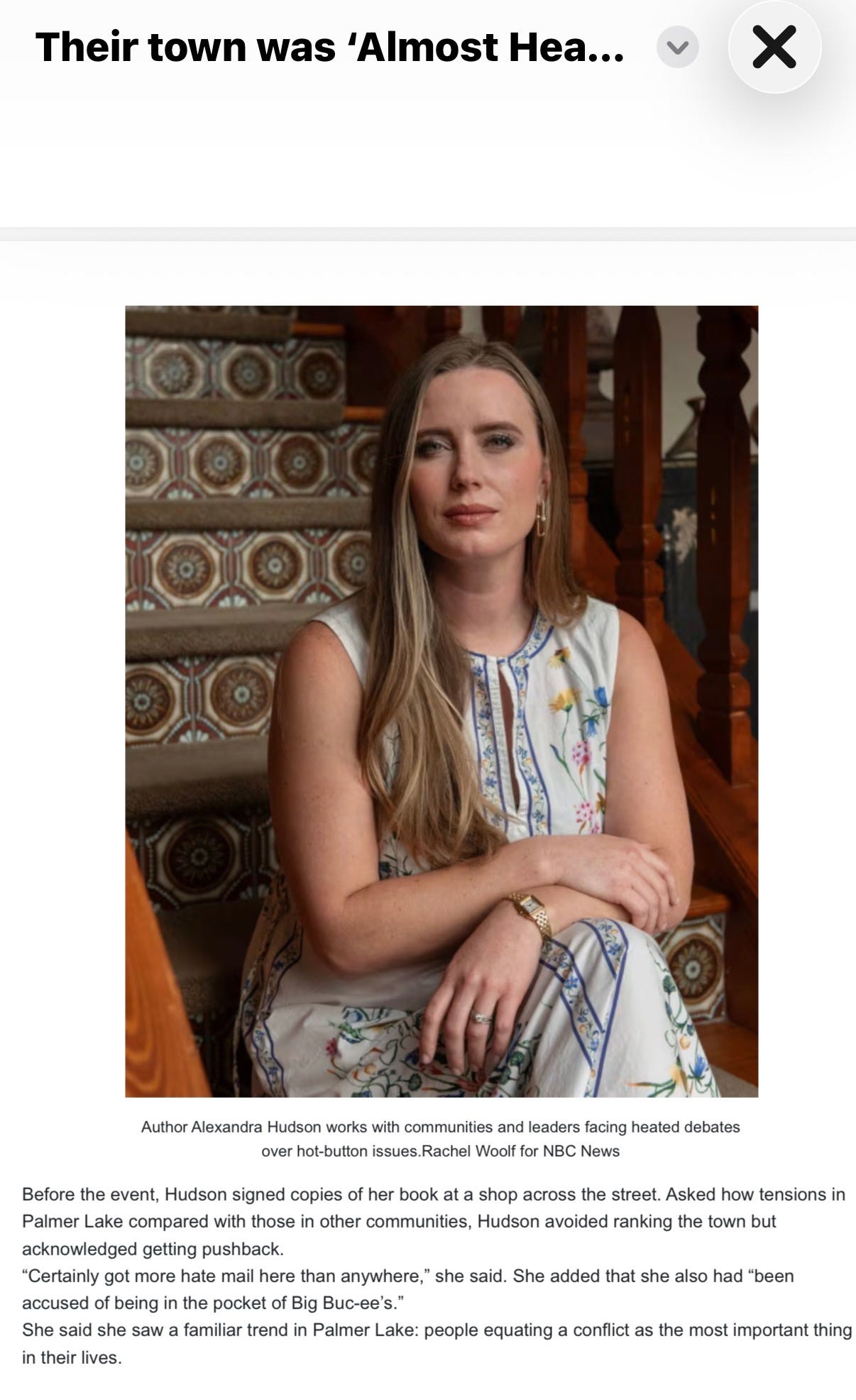
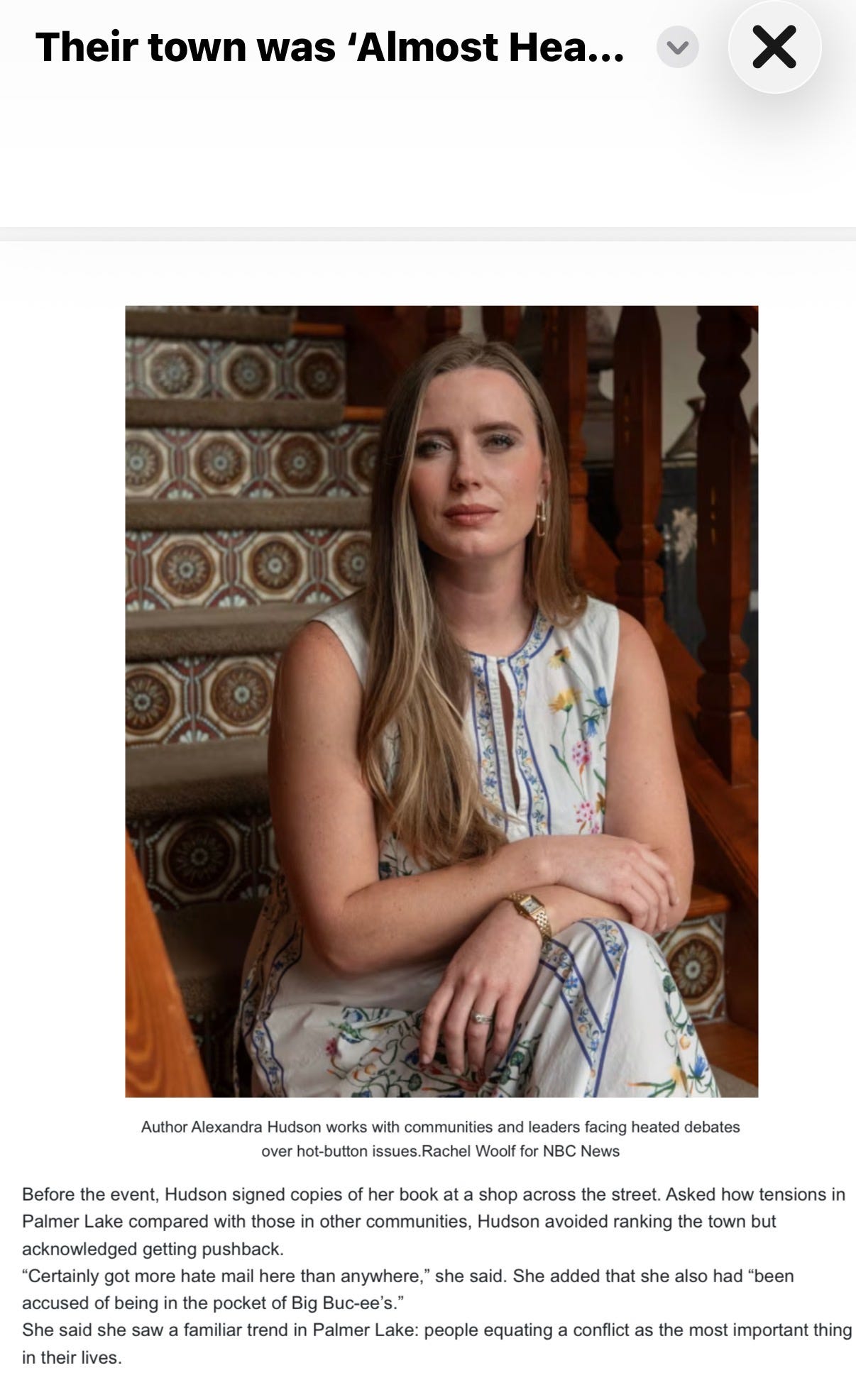
“We’re fun, we have beautiful spaces, we have great traditions — and we’re getting known for negativity,” said Albright, who is running for a trustee position and said she had quietly opposed Buc-ee’s. Author Alexandra Hudson works with communities and leaders facing heated debates over hot-button issues.Rachel Woolf for NBC News Before the event, Hudson signed copies of her book at a shop across the street. Asked how tensions in Palmer Lake compared with those in other communities, Hudson avoided ranking the town but
acknowledged getting pushback. “Certainly got more hate mail here than anywhere,” she said. She added that she also had “been accused of being in the pocket of Big Buc-ee’s.” She said she saw a familiar trend in Palmer Lake: people equating a conflict as the most important thing in their lives.
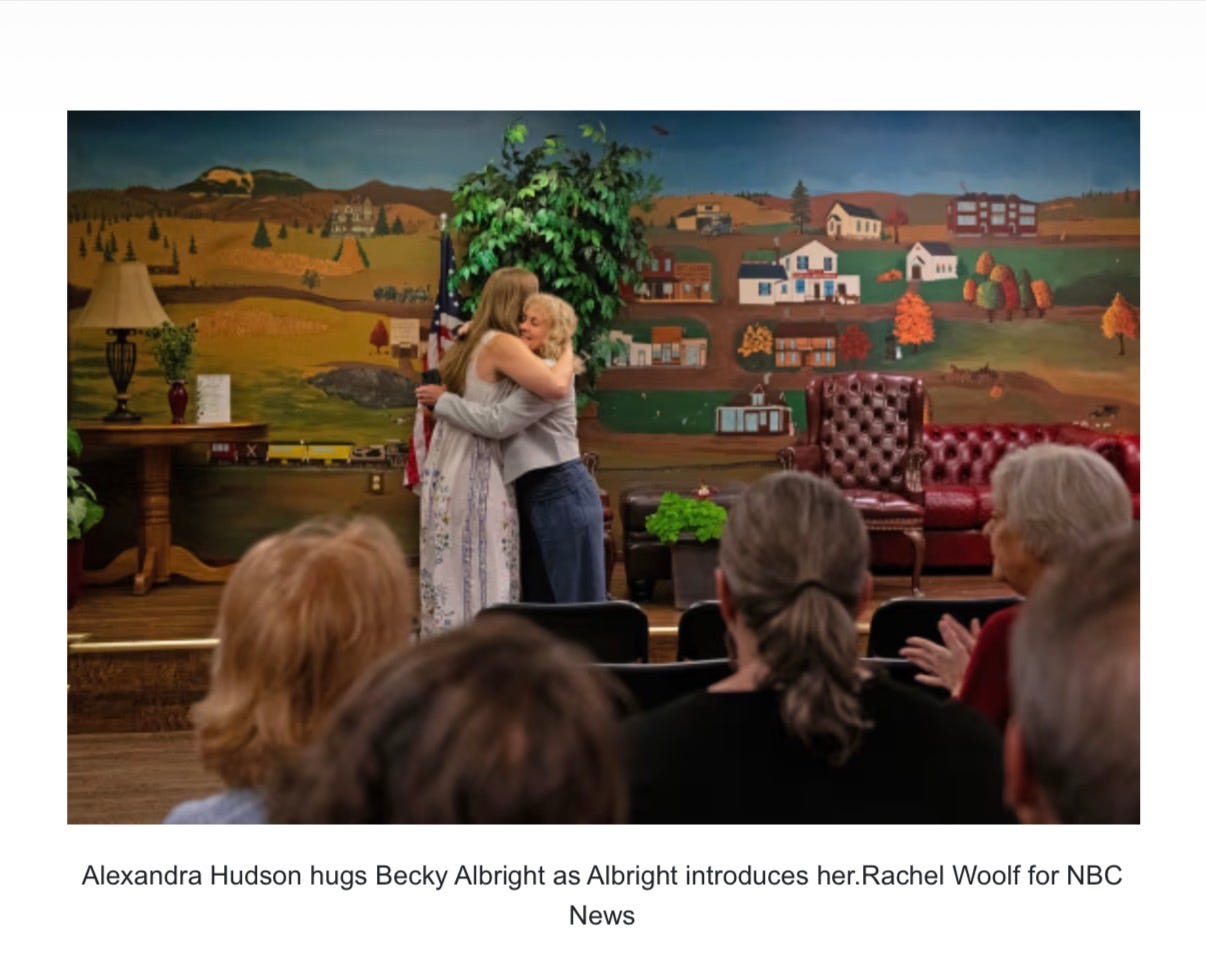
During her lecture, Hudson told the audience that the town could have a new chapter. “It’s unfortunate that this community has become a poster child for our country’s national division,” she said. The crisis, she said, is about not disagreement but dehumanization. “We are always going to disagree. Say that with me,” she told the crowd, which repeated her words in
unison. After Hudson spoke, people discussed what had gone wrong.Susan Miner, a former Palmer Lake trustee, mused that the discord was driven by out-of-towners meddling to help residents sue. Other participants made a suggestion that harked back to the old Palmer Lake: The town’s repair, they said, could start with moonlight hikes instead of isolation. Beyond the civility event, both sides have begun to reflect and — to Hudson’s point — see the nation’s
divide in Palmer Lake.
Read the full of the NBC exclusive reported piece here or the PDF below:

More of The Soul of Civiltiy the News:
For The Tennessean, and in advance of the Global Free Speech Summit where I moderated a panel on free speech and antisemitism with Nadine Strossen, I wrote about Uncivil vs. The Civiltiy Industrial complex, and why true civiltiy requires disagreement. Read it here.
An honor to join Focus on the Family President Jim Daily for a conversation about civility grounded in imago dei and human dignity in an age of contempt. Listen here.
In the Gazette of Colorado Springs, Rachel Stovall writes a lovely article about what we have built there over the last several years. Springs leaders emphasize civility’s importance.
She writes, “Alexandra Hudson, author of The Soul of Civility, has built an entire national conversation around that distinction. Her book took her on a 50-city tour around the globe. In Carmel, Indiana, a question from a city councilman, ‘how do we actually embody these ideas in our community?’ morphed into a Civility Summit bringing together more than 100 civic leaders from 17 states and Canada.”
An honor to join John Anderson, former Deputy Prime Minister of Australia, on his platform “Our Civilizational Moment” for a wide ranging conversation about civility and power across human history. John is the best! Listen to the full conversation here.


