

Gracious reader,
This reflection is open to all subscribers.
If something here speaks to your own longing for rest or inspiration—and you'd like to go deeper—you're warmly invited to join one of the higher tiers, where I share weekly essays, reading recommendations and more.
As a new school year begins— with students heading off to college, teachers returning to classrooms, and parents adjusting to the rhythms of drop-offs and homework—it’s easy to hope that everyone will simply “be nice” and get along. In our age of cultural conflict and educational polarization, many grasp for civility as a way to keep the peace. But true civility isn’t about avoiding disagreement or smoothing things over. It’s about how we show up—in the carpool line, on the PTA board, in the lecture hall—with integrity, clarity, and respect, even when values collide. Especially then.

Civility is more than manners and politeness. It is not just about “talking nicely.” It's about honoring the dignity of others even when—especially when—we disagree. So before we resign ourselves to gritted teeth pleasantries or walk away from difficult conversations altogether, here are five reminders of what civility isn’t:
1. Civility is not the same as politeness.
Politeness is about surface-level rules of etiquette: the please-and-thank-you choreography of social life. Civility, by contrast, is about moral posture. It’s about how we treat people, not just how we talk to them. Politeness can be used to avoid, deflect, or manipulate. Civility invites us to show up—with courage and integrity—even when it’s uncomfortable.
2. Civility doesn’t require agreement—or even the pursuit of it.
This summer, you don’t have to find “common ground” with your politically opposite cousin or contrarian coworker. Sometimes, we are so desperate for harmony that we force consensus where it doesn’t belong. Civility doesn’t mean pretending differences don’t exist. It means respecting others enough to let those differences be real.
3. Civility is not moral relativism.
Too often, people invoke “civility” to suggest all ideas are valid, or that disagreement itself is somehow impolite. But some ideas aren’t just wrong—they’re dangerous. Civility doesn’t ask us to tolerate the intolerable. It demands that we condemn evil without dehumanizing those who perpetuate it. It’s a high bar—and a necessary one.
4. Civility is not conflict-avoidance.
We’ve confused civility with comfort. But real civility embraces tension. It allows us to say, “I think you’re wrong,” without implying, “You don’t belong here.” It invites passionate debate that doesn't descend into cruelty or contempt. If your goal is never to offend, you’re not being civil—you’re being evasive.
5. Civility is not weakness.
In a culture that confuses rage with righteousness, practicing civility can feel like surrender. But nothing is more radical—or more difficult—than refusing to dehumanize in return. It takes extraordinary strength to meet incivility with clarity and self-command. This is not passivity. It’s principled resistance.
As we step into this new academic year—with all its promise, pressure, and potential for friction—let’s not settle for a shallow civility that prioritizes comfort over courage. Instead, let’s model a deeper, more demanding civility for our children, our students, and ourselves: one that embraces truth without cruelty, holds conviction without contempt, and navigates disagreement without dehumanization. In classrooms, cafeterias, and campus quads alike, may we teach not just what to think, but how to live together with dignity.
Are you a teacher who wants to bring the language of ability into your classroom? I’d love to hear from you. We’re developing a curriculum to support educators in creating strong discourse—and your insight can help shape it. Contact me at ahudsonassist@gmail.com, and let’s build it together!
Invitation:
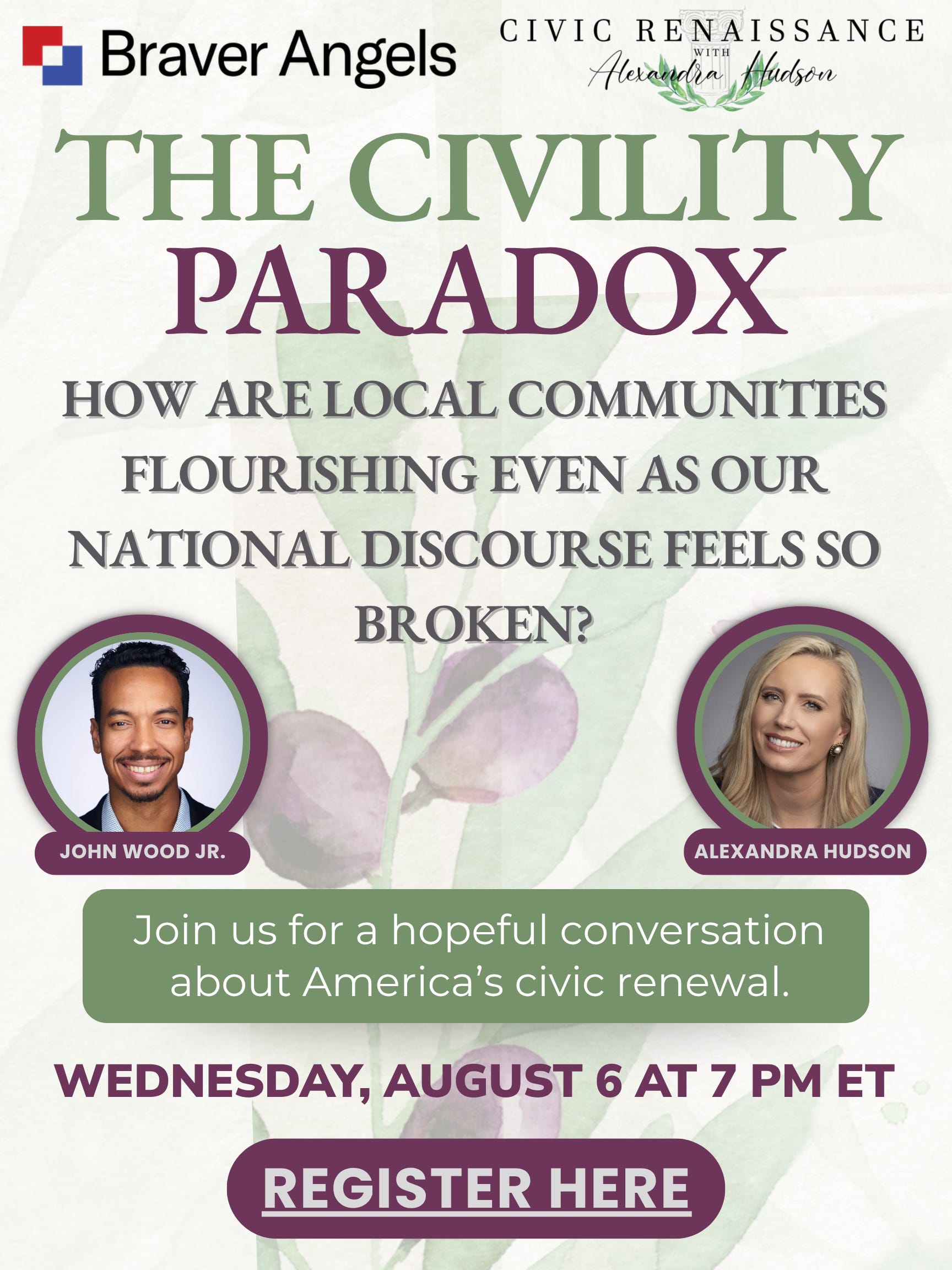
You're invited to join me and my friend, John Wood Jr., for an inspiring conversation about America's civic renewal. Register here!
Looking ahead:
August 28, 2025- Indiana Women's Collaborative, Indiana Chamber of Commerce
September 9, 2025- Indiana University Bloomington
The Polo Club of Boca Raton, November 3, 2025
In the news:
Mindful Money Podcast: The Lost Art of Civility with Alexandra Hudson
My 4-year-old asked for a smartphone. Here's what I did next as a parent.- In my new USA Today piece, I reflect on why my son wanted a phone so badly: 'If adults are perpetually distracted by their phones, the message is clear: Presence with others takes a backseat to screens.'
The Steep Price of Declining Civility- “Moral habits that promote human flourishing are virtues. Moral habits that divide us — within ourselves and between us and others — are vices.”- Thank you for mentioning my book, The Soul of Civility, in this thoughtful article!
The Bryan Hyde Show- Every single one of us can be a civilizing influence wherever we happen to be standing. Barry Brownstein reviews Alexandra Hudson's book "The Soul of Civility" and explains our personal duty to be a source of civil behavior. Any time we find ourselves a little too up-to-date on what's happening politically, it's time to take a step back and regain our perspective.
Is Silence Violence? How Yale Law School Reminded Me of the Virtue of Viewpoint Neutrality- “Viewpoint neutrality isn’t weakness — it’s a principled stand that respects disagreement and protects civil discourse.” Sharing my latest for WSB blog — interested to hear your thoughts!
The World’s Oldest Stories to Help Your Relationships! With Alexandra Hudson- Truth Changes Everything Podcast
Currently Reading & Loving:

My friend Karen Swallow Prior has written a beautiful book on vocation—a word rooted in the Latin vocare, ‘to call’.
She reminds us that our calling isn’t about striving, grasping, or climbing ladders, but about being attuned to truth, goodness, and beauty. When we pursue these transcendentals, she writes, we’ll find ourselves right where God wants us to be.
As someone who finds real joy in my work—storytelling, conversations, immersing myself in the world of ideas—I also know the temptation to let what I do become who I am. Karen’s book is a timely and wise antidote to the many distortions modern life encourages around work, identity, and worth.
It’s a deeply grounding reminder: we’re not called to hustle ourselves into exhaustion—we’re called to live lives of meaning, virtue, and alignment.
I’m loving it so far and think many of you will as well.
A Year Ago on Civic Renaissance:
Why do philosophers have long beards?
Thank you for being part of our Civic Renaissance community!

Regarding one of Hudson’s reminders of “what civility isn’t”:
“But some ideas aren’t just wrong—they’re dangerous. Civility doesn’t ask us to tolerate the intolerable. It demands that we condemn evil without dehumanizing those who perpetuate it.”
I paused at this. It reveals a deeper tension in Hudson’s approach to civility. On the surface, she makes a fair and admirable point: disagreement is inevitable, and we should handle it without contempt. But then she draws a clear line—some views are too “dangerous” to be tolerated. That’s where things get complicated.
To me, this move turns civility into something else: a way of filtering who gets to participate in public discourse, not based on how they speak, but on what they believe. The speaker still claims the moral high ground—condemning without dehumanizing—but the gate is already closed.
Oxford's Teresa Bejan, in her book "Mere Civility: Disagreement and the Limits of Toleration," is helpful here. She looks to Roger Williams, the seventeenth-century dissenter who believed that real pluralism means tolerating even the people whose views you find outrageous, heretical, or offensive. His “mere civility” does not ask for respect, even for respect of liberty! It asks for the bare minimum of forbearance—enough to keep the conversation going.
No wonder he’s often called the Father of American Pluralism. In Rhode Island, Williams built a society where even those he believed were bound for hell had a place in public life. Their right to speak and participate wasn’t contingent on being “reasonable” or “moral”—it was part of what civility demanded.
I don’t doubt Hudson’s sincerity. Her tone is warm, and her desire to elevate the national conversation is clearly genuine. But when civility becomes entangled with moral gatekeeping—when we’re told to “condemn evil” but not dehumanize, as if those lines are always easy to draw—it stops being a tool for inclusion and starts functioning as a boundary-setting exercise.
To be honest, I find myself drawn to Hudson’s eloquence. But I also think it’s ill-suited to the messy, angry, polarized world we’re actually living in.
The trouble with high-minded civility is that it still decides who gets to speak—and who must be spoken for. - This is old-fashioned conservatism dressed up in its Sunday best.
This is an important distinction you make—poorly understood by many people who insist that we must respect their beliefs. We must only respect their liberty and not their bad ideas and beliefs.
Great post.