Civic Renaissance has always been a space to reflect on timeless ideas: beauty, virtue, memory, and wisdom, to help us live more thoughtfully today. As Cicero said, “If you have a garden and a library, you have everything you need.” This space is meant to be both.
Gracious reader,
Today I want to share a vulnerable story. (For some reason only 11 seconds of the video version of the story was recoded, but thankfully I recorded it on a voice memo as well for you to enjoy the full audio story).
Recently, I made a mistake that hurt and disappointed someone I admire and respect. There was no excuse. No ambiguity. I failed to do what I said I would do. Twice.
A Civic Renaissance ambassador, a generous supporter of my work, had organized a church-wide reading of my book. He told me it was the most well-attended Bible study his church had hosted in years. He asked whether I would join their group on Zoom to answer questions and discuss the ideas together. I said yes, gladly.
The first Sunday arrived. I went to church and left my phone at home. I missed the call.
I was mortified. I apologized, without reservation, and asked to reschedule. He was gracious.
We set a new date.
The second Sunday arrived. My husband made pancakes. We read an Advent devotional together. I was offline again, fully present with my family, honoring the Sabbath in the way I try to. Thirty minutes into the call, my husband was alerted that I had not joined.
I had missed it again.
What followed was not just embarrassment. It was the sharp awareness of a familiar human reflex: the urge to find someone or something else to blame and to self-justify. Why had no one reminded me? Why had the calendar failed? At least I was doing something noble in being present with my family… The list of excuses in my head went on.
I caught myself doing this and stopped. Even naming the tension between ideals, presence with family versus a commitment to others, was a form of rationalization. The truth was simpler and harder.
I forgot.
I failed.
Full stop.
This was painful not only because I disappointed someone else, but because I disappointed myself. I carry an identity as someone who shows up, who honors commitments, who is careful with the trust of others. Confronting my own fallibility, without deflection, was uncomfortable.
Blame is a default response. In the Genesis story, Adam blames Eve. Responsibility is passed along because it is hard to sit with our own shortcomings. As Blaise Pascal suggested, much of our discomfort comes from the inability to sit quietly with ourselves. When we do, we are confronted with who we actually are, not who we imagine ourselves to be.
Blaise Pascal writes in the Pensées (fragment commonly numbered 139 or 168, depending on the edition): “All of humanity’s problems stem from man’s inability to sit quietly in a room alone.”
Friday evening, we hosted a conversation on disillusionment for Civic Renaissance Subscribers called The Joy We Forgot. Junius Johnson, a Yale-trained scholar and storyteller, joined us. He made a simple point that has stayed with me: we are disillusioned by people and institutions when we expect too much of them.
I had expected too much of myself. And I have been disillusioned in life when I’ve expected too much from others. When we place our faith and hope in a relationship with another human being, we set ourselves up for disappointment: no imperfect human can carry that faith and expectation without stumbling.
We experience this everywhere. People are disillusioned by politics, by institutions, by leaders, by spouses, by parents. I have been disillusioned before. As a child, when I realized Santa Claus did not exist. Later, when I entered federal government expecting something like The West Wing and encountered something closer to cynicism and dysfunction. In both cases, the disappointment came from misplaced expectation.
When we place ultimate hope in fallible people or temporal structures, disappointment is inevitable.
Part of what made this recent failure so painful was the need for self-forgiveness. I expected myself to be more than I am. I expected perfection when perfection is not possible.
Working through that, without spiraling into shame, required grace.
Grace, once received, changes how we treat others. Tim Keller often observed, paraphrasing his teaching, that the unforgiving heart is the unforgiven heart.

Put another way, those who grasp how much they have been forgiven are more able to forgive. When we forget our own capacity to harm, resentment hardens. When we remember it, generosity becomes possible.
This is why the no-excuse apology matters.
A real apology does not explain itself. It does not justify. It does not reframe. It names the harm and stops. That kind of apology is rare, and it is costly. It requires relinquishing the comfort of self-protection.
It also makes repair possible.
Wabi Sabi parenting
This lesson matters in our homes as much as anywhere. My children do not need a perfect parent. They need a parent fluent in apology and forgiveness. When I lose my temper, the repair must be immediate and unqualified. Children learn how to live with others by watching how adults handle failure.
Repair strengthens relationships rather than weakening them. Wounds that are acknowledged and tended do not destroy trust. They can deepen it.
Erasmus of Rotterdam understood this. Paraphrasing Erasmus, he counseled people to readily ignore the faults of others, and avoid falling short ourselves.
We should be quick to overlook the faults of others, careful to avoid falling short ourselves, and slow to accuse. This runs directly against the grain of our culture, which trains us to scrutinize others while excusing ourselves.
Blame is seductive because it absolves us. Responsibility is harder, but it is the beginning of growth.
I want to be clear. We are going to be disappointed in life.
I will disappoint you. Others will disappoint you. No leader, institution, party, or cause is immune. Disillusionment is unavoidable unless our deepest hope rests in something that does not depend on human perfection. For me, that grounding comes from the Christian faith, which begins not with our striving but with Jesus Christ, whose life, death, and resurrection confront human failure honestly and offer grace not as an idea, but as a gift given to us.
An invitation to no-excuse forgiveness
If there is someone you need to ask forgiveness from, do it plainly. If there is someone you need to forgive, consider the ways you have needed grace yourself. If you need to forgive yourself, remember that failure is part of being human, not the end of the story.
We are not defined by our worst moments. We are shaped by how we respond to them.
Heroes and Villains: Would you like to read my children’s book?
If you would like to read early drafts of the children’s stories I am writing, adaptations of figures like Gilgamesh, Augustine, Hannah Arendt, and Erasmus for families and classrooms, I would welcome your feedback. I am actively seeking responses from parents, teachers, and school leaders. Respond to me via this email, and share with me if you’re a parent, educator or administrator—or passionate about instilling civility and grace in the next generation—and I’d love your thoughts!
And if this reflection resonates with you, I invite you to subscribe to Civic Renaissance. This work exists to help us recover practices of responsibility, repair, and shared life that make flourishing possible, especially when we fall short.
Warmly,
Lexi
In the News
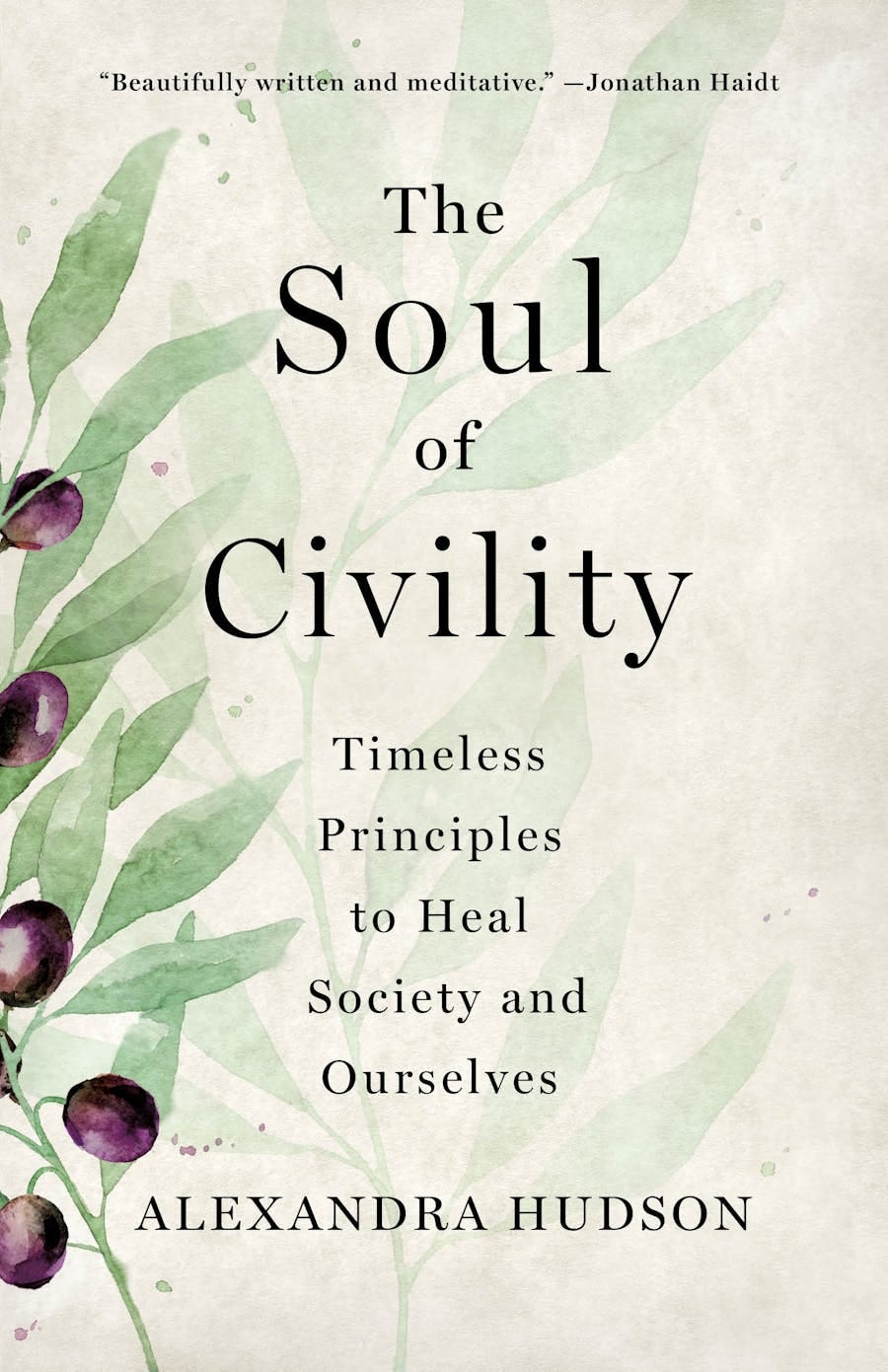
PBS: Author Alexandra Hudson explores the difference between politeness and civility: Steve Adubato welcomes Alexandra Hudson, author of “The Soul of Civility: Timeless Principles to Heal Society and Ourselves,” to explore the difference between politeness and civility, and how embracing human dignity can bridge the divide in times of political tension.
Indy Politics: Holiday Survival 101: How To Deal With “That One Relative”: The holidays are here, which means two things: calories don’t count, and every family has at least one relative who makes you question the Geneva Conventions.
So with Thanksgiving and Christmas knocking, Abdul Hakim-Shabazz talked with Alexandra Hudson, author of The Soul of Civility, to get some wisdom for those of us preparing to sit across from Crazy Aunt Agnes, Uncle Blah Blah, or That Cousin Who Thinks Facebook Is a Peer-Reviewed Journal.
The Enneagram + Marriage Podcast with Christa Hardin: Culture Wars, The Family Table, and True Civility with Author and Storyteller Alexandra Hudson
Mentor in Residence Opportunity
We are seeking an extraordinary person to join our family and the Civic Renaissance team as a Mentor in Residence. This role is for someone who loves children, loves learning, and wants to help cultivate a rich atmosphere of curiosity, beauty, kindness, and intellectual life for three young children ages five, three, and one.
Our home is an atelier, a space of creativity, innovation, learning. It is a place of ideas, stories, nature, music, art, conversation, and unhurried discovery. We are building an educational model for our family that brings together nature exploration, early literacy and numeracy, storytelling, cultural formation, ample leisure and unstructured free time, and the joy of hands-on making. We hope to share this model with other families over time.
We are looking for a guide who brings presence, steadiness, imagination, and an instinct for wonder. You do not need classroom experience. We care about your character, your curiosity, your capacity to listen well, your intellectual interests, and the way you see children and human flourishing.
This is a national search, and we welcome candidates who are open to relocating to Indianapolis. Please share widely.
Year Ago on Civic Renaissance:
Water & Fire: Restoring Our Home, Restoring Ourselves
Thank you for being part of our Civic Renaissance community!