

A quick note before we begin: I had technical difficulties with the video (twice!), so it cuts off before the end. Apologies! The full reflection is written out below. And one correction: in the video I say today marks Dostoevsky’s death. In fact, today is his birthday. He was born on November 11, 1821.
Gracious reader,
I hope you’ve had a wonderful week so far. I’m so excited to share that a new book by a friend, and a writer I’ve admired for a very long time, is out this week: Robert Greene’s The Law of the Sublime. Robert kindly sent me an advance copy months ago, and I have been ruminating on it ever since. It is an unbelievable book.
And because it’s too good not to share, I’m giving away copies to Civic Renaissance readers. Details are at the bottom of this post, along with a gift from me to you.
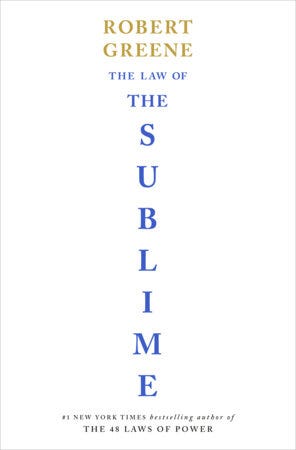
My theory about Robert Greene
You may know Robert as the author of The 48 Laws of Power, a book that has been banned in prisons. If that doesn’t make you want to read it, I don’t know what will. Its premise is that power is like gravity: either you understand its laws and learn to operate within them, or they are used against you. So you might as well know what they are.
Robert has been maligned over the years as a modern-day Machiavelli, ridiculed for supposedly advocating immorality. But I have a theory. I think he is actually advocating for conventional virtue, couching it in the laws of power and appealing to our desire for power so that we read the book and then live out very conventionally virtuous practices. Do what you say you’re going to do. Keep your promises. That is about as conventional as moral teaching gets.
Many of the laws in his book are stories and ideas I also tell in The Soul of Civility. I wrote my book before I ever read his, but we draw from the same intellectual well, tell similar stories, and come to similar conclusions. I consider him an amazing thinker and a fellow traveler, and I’m so grateful for his friendship and his work.
What is the sublime?
The sublime is not just the pretty or the nice. Something beautiful makes us feel good; the sublime instills fear and awe. It shakes us to our core and humbles us. Edmund Burke wrote about it in his famous essay on the sublime and the beautiful: the thunderstorm, ferocious waves crashing on the shore, the contemplation of infinity and space.
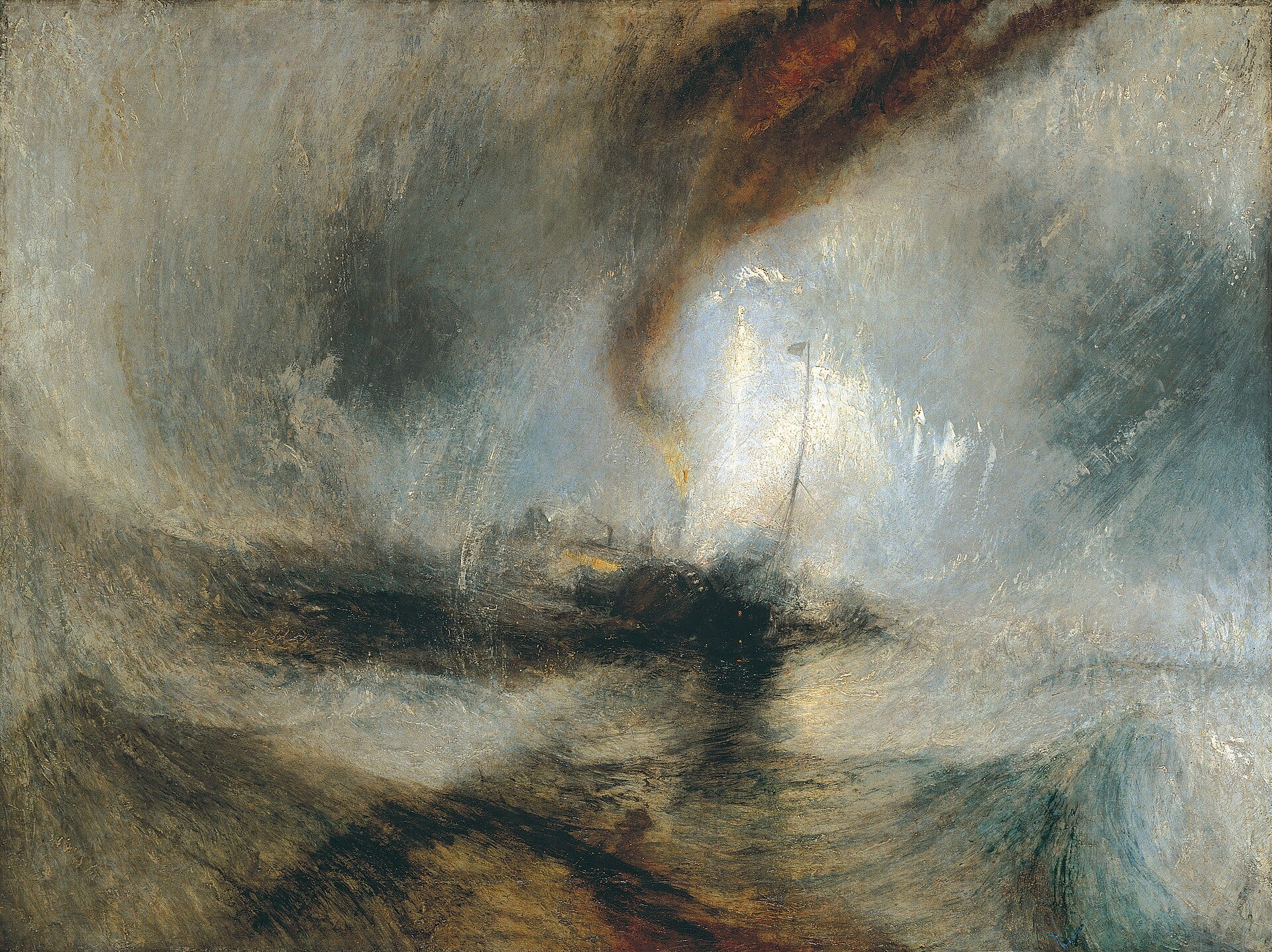
I write about the sublime in the final chapter of The Soul of Civility because it shakes us from the naive illusion that we are the center of the universe and that everything revolves around us. It shakes us from our pettiness, from what the philosopher Iris Murdoch called “the fat relentless ego,” which we all have to combat day in and day out. The sublime reminds us that the world is vast and beautiful, and that we are an infinitesimal part of it. It puts us in perspective.
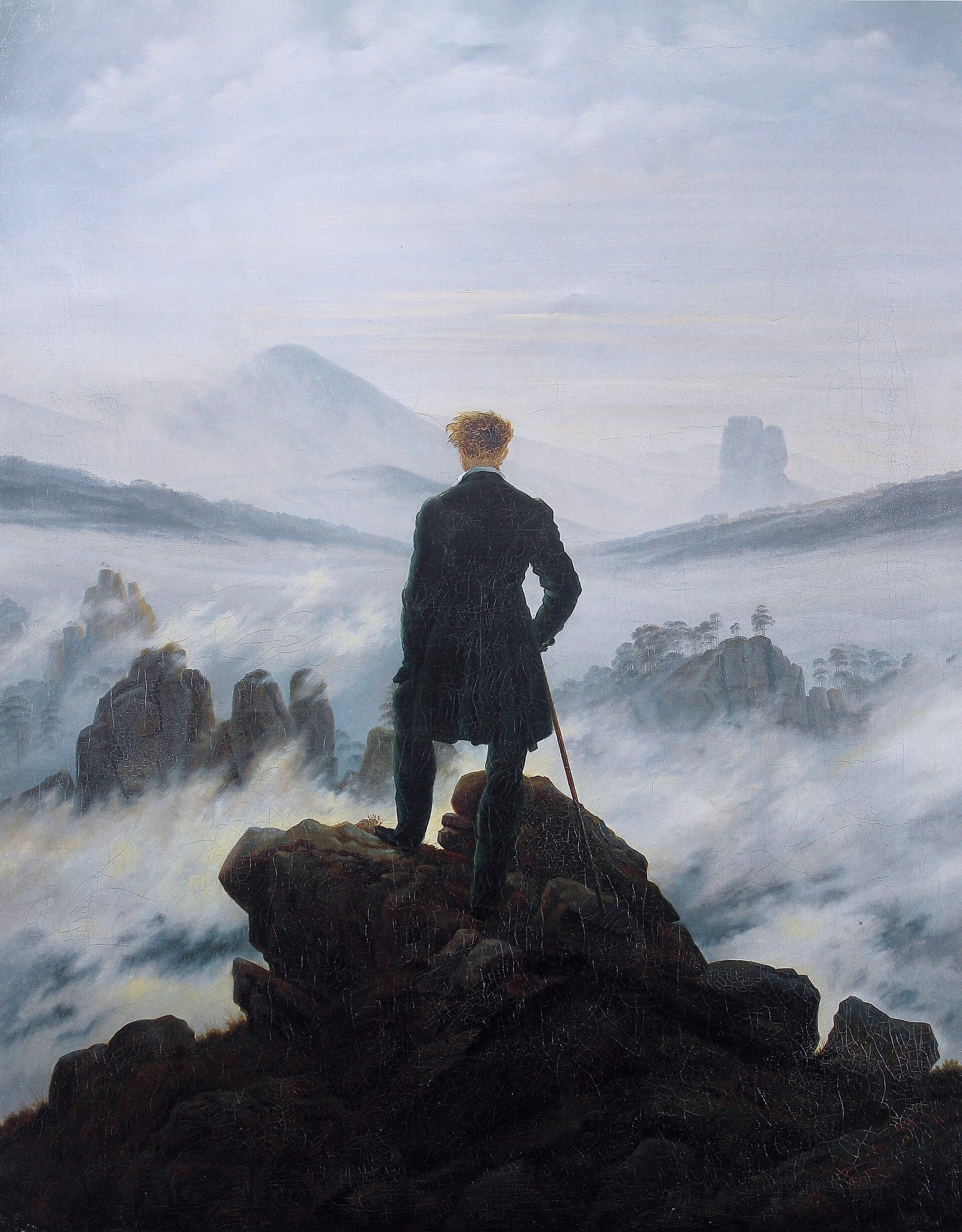
A book about the sublime, written from four walls
Robert first had the idea for this book decades ago. His plan was to go on all kinds of awe-inspiring adventures and then write about them. Then, in 2018, everything changed. He writes:
“It was a hot August afternoon in Los Angeles. I was driving my car, my girlfriend seated next to me. Suddenly I heard her yelling to pull over: She had noticed that I was badly slurring my words, and then she realized that one half of my face was drooping. She promptly called 911. I was having a stroke.”
After the stroke, he could barely walk. The adventures were no longer possible, so he had to find the sublime right where he was:
“My original concept for The Law of the Sublime some twenty years ago was that I would participate in all kinds of awe-inspiring adventures—voyaging down the Amazon, encountering chimpanzees in the wilds of Africa, etc.—and have sublime experiences to write about. Now, however, I could barely walk out the front door… I decided I would have to find the Sublime in the narrow spaces I now occupied… Now my small backyard would have to be my Amazon jungle.”
That limitation became a gift. As he puts it, the sublime “does not require travel or exotic adventures or any kind of physical exertion. It simply requires a new pair of eyes to see the reality all around us.”
This is what I love most about the book. You don’t have to hike Kilimanjaro or go to Antarctica to encounter the sublime. Robert walks us through the sublime of life itself, the cosmos, the limits of human knowledge, and the everyday. He reminds us of “the highly improbable chain of circumstances that have led to our present existence.” Life is a miracle. I walked away with an enhanced appreciation of the gift of being human, the beauty of the world around us, and the preciousness and fragility of life.
One passage struck me as a description of civility itself. Robert calls it “the Shock of the Other”:
“The Sublime is an encounter with the Other, with consciousnesses that are different, sometimes radically so, from our own… With people, we do not project onto them our values and beliefs, but rather connect to them on a nonverbal level, sensing their emotions and trying to experience the world through their eyes.”
That is the heart of what I mean by flourishing across difference: seeing the person across from us not as a category, but as a whole and inexhaustible human being.
Excerpts are from the advance edition of The Law of the Sublime, which Robert kindly shared with me; the final text may differ slightly.
Happy birthday, Dostoevsky
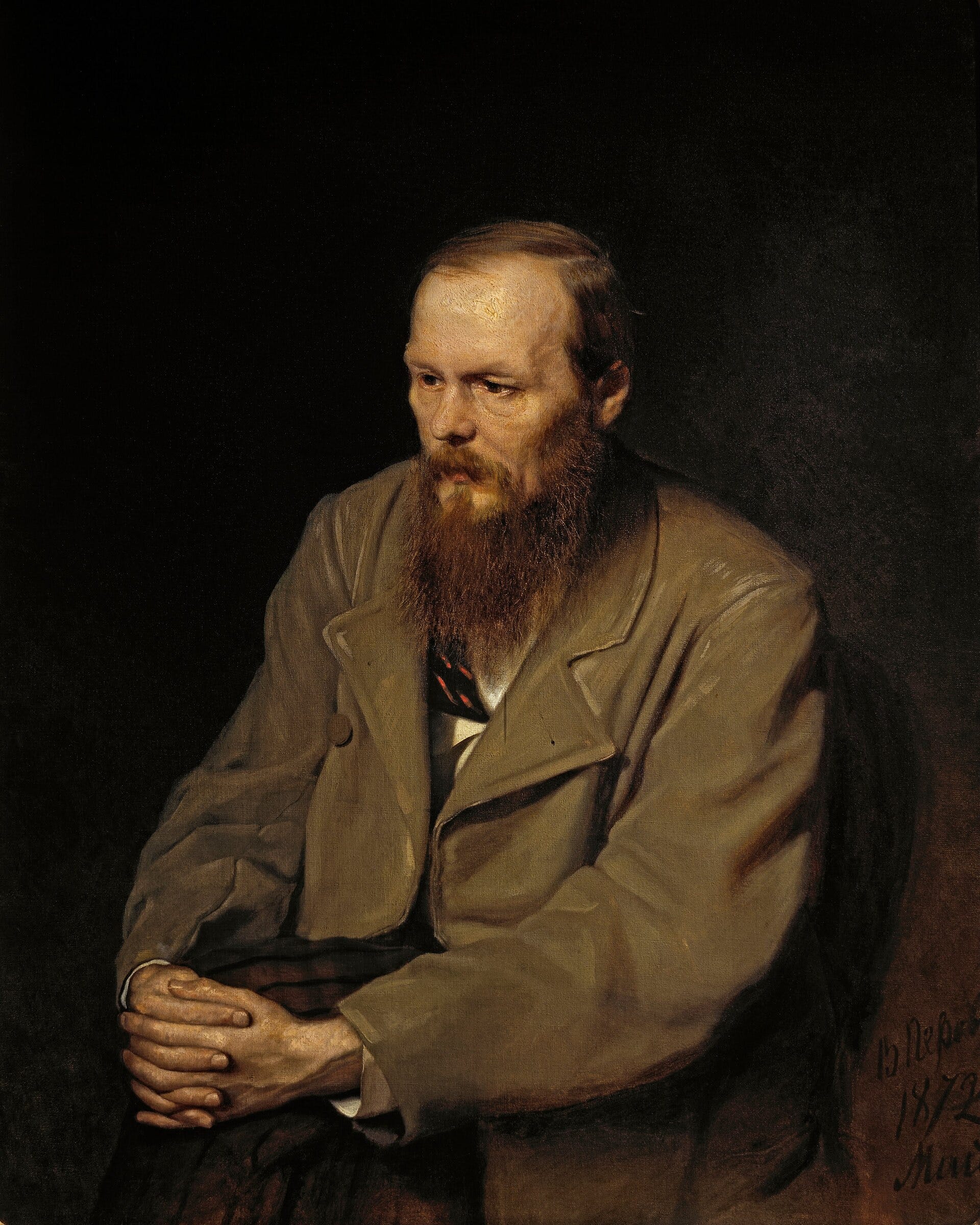
Fyodor Dostoevsky was born 205 years ago today. When I went on Ryan Holiday’s Daily Stoic podcast, Ryan gave me a copy of Robert’s The Daily Laws, and its entry for December 19 tells Dostoevsky’s story.
In December 1849, Dostoevsky was arrested for an alleged conspiracy against the tsar. Suddenly he found himself in a square in Saint Petersburg with his fellow prisoners, about to be executed, with only minutes to prepare for death. Robert writes that in those minutes Dostoevsky noticed the rays of light hitting the dome of a cathedral, and saw that all of life was as fleeting as those rays. At the last moment, a messenger from the tsar rode into the square: their sentences had been commuted to hard labor in Siberia. Dostoevsky felt reborn. That night he wrote to his brother, “Life is a gift, life is happiness.”
Robert draws this lesson from the story, and I love it:
“Imagine that you have been spared from a death sentence, now and every day… Live accordingly.”
Robert had his own brush with death, and it gave him a far deeper appreciation of the gift of life, and of others. The same is available to us, without the scaffold and without the stroke.
For your week
The practice (heart): Live one day this week as a day you didn’t think you would get. Then look again at one person in it. The word respect comes from the Latin specere, “to look.” To respect someone is to re-inspect them, to see them as they really are.
For your commonplace book: “Life is a gift, life is happiness.” (Dostoevsky to his brother, December 22, 1849)
For your table: When did a moment of awe, or a close call, change how you saw the people around you?
The giveaway
I’m giving away copies of The Law of the Sublime. To enter, share in the comments below a moment that filled you with awe: a mountaintop, a birth, a close call, a piece of music, a stranger’s kindness. A sentence or two is plenty. I’d love to hear it.
Entries close Wednesday, November 18. I’ll choose winners at random from the comments and email them for a mailing address.
A gift for you
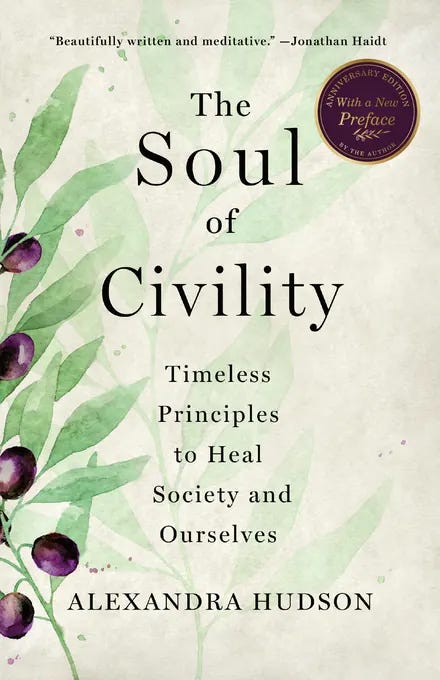
The sublime is often closer than we think: on a porch, at a table, in the face of a neighbor. That is the idea behind the Porching Challenge, my invitation to gather a few people and read The Soul of Civility together. When you join, I’ll send you the introduction and first two chapters free, plus discussion guides and invitation scripts, and your porch will go on the Porching Map beside readers across the country.
Where The Soul of Civility is at work
Leaders across politics, geography, and vocation are using the book to build cultures of flourishing across difference. A few of their stories:
Palmer Lake, Colorado. A town torn apart over a proposed Buc-ee’s gathered leaders and residents from all sides to begin repairing their civic life. Watch the story and read NBC News’ coverage.
Carmel, Indiana. After contentious elections, leaders launched Project Civility and hosted the first National Civility Summit, drawing mayors and lawmakers from 17 states and Canada. Watch.
Shelbyville, Indiana. A community fractured by a proposed data center turned to the book as a shared language for disagreeing without dehumanizing one another, with over 250 participants. Watch.
Urbandale, Iowa. Not a city in crisis, but a healthy one that wanted to get better, so the mayor made the book the community read. Watch.
The Texas Legislature. It began with one Democratic state representative reaching out to a Republican colleague. Today members of both parties and both chambers read the book together over legislative dinners.
Arizona City Managers Association. The story of Arizona’s city and county managers, from crisis to renewal. Watch.
St. Ambrose University, Iowa. A professor built a course around the book, and the university brought in community partners to support a faculty conversation and keynote. Watch.
Read more in The Wall Street Journal’s review and on my website.
Happy birthday, Dostoevsky. Congratulations, Robert. And to you, dear reader: may you find the sublime right where you are this week.
Warmly,
Lexi
This coming Saturday my wife, Norma, and I will be celebrating the awe of her surviving a horrendous accident on 11/14/24. While simply walking across a road, she was clipped by a Ford F-150 truck and bounced 20-feet in the air, scraping his passenger mirror and having her leg run over by one of his tires. She was carrying two packages, with a Christmas tree topper and a holiday wreath. When they returned our goods, the wreath was mangled while the angel tree topper was not scratched or dented. We have anointed 11/14 to be Guardian Angel Day, celebrating the fact that she survived three major surgeries, 50 days in the hospital/rehab center and the specter of losing her leg.
Earlier this year, I traveled down to Crittenden County, Kentucky, to attend the 100-year anniversary of the Hudson Mine Rescue. Porching and a strong sense of community have always been the center of this place that I visited every summer during childhood in the 90s.