The Launch of the Civic Renaissance Tour
A community-led movement for civic renewal
Gracious reader,
I wanted to share more with you about the launch of the Civic Renaissance Tour launch in Shelbyville, Indiana, in late January.
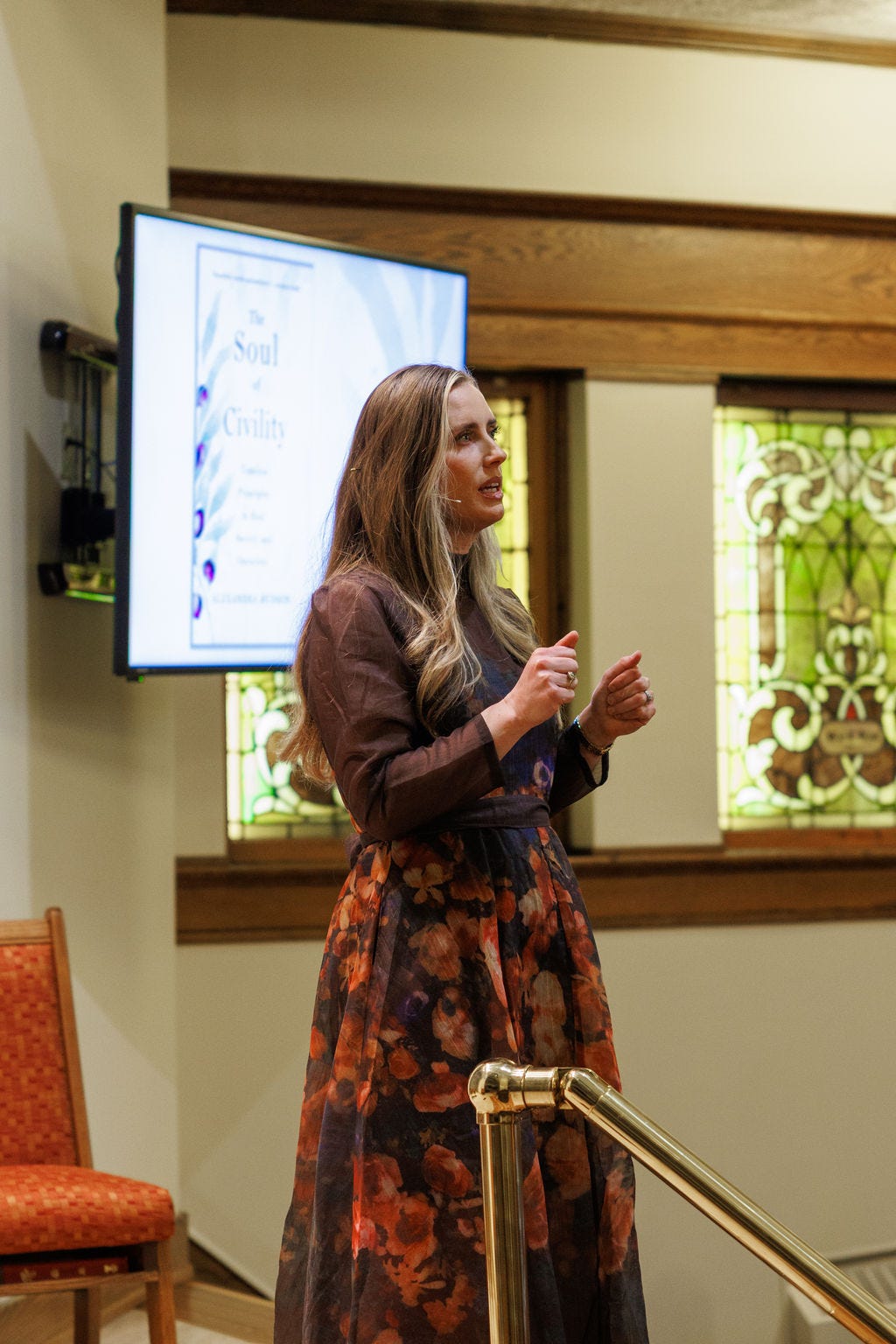
Rather than narrate it myself, I want to pass the microphone to pastor of First Church Shelbyville, Rev. Ralph Botte, who initiated this effort in Shelbyville. He carried a clear vision for his church to help lead a community moment during a time of dehumanization and division, using the tools and framework of The Soul of Civility. I’ll let him share what the experience meant, to him and his community, in his own words below.
Here are select upcoming initiatives on the Civic Renaissance Tour in the months ahead:
Ithaca, New York (Cornell University)
Portland, Oregon
South Bend, Indianapolis, Valparaiso, Bloomington, Evansville, and Shelbyville, Indiana
Colorado Springs and Estes Park, Colorado
Urbandale, Iowa
Grand Rapids, Michigan
Pittsburgh and Philadelphia, Pennsylvania
London, England
Perth and Sydney, Australia
New Zealand
Austin, Houston and Dallas, Texas
Richmond, Virginia
Toronto, Canada
Cincinnati, Ohio
Milwaukee, Wisconsin
Boston, Massachusetts
Washington, D.C.
Communities across Arkansas
If you do not see your community listed here, that does not mean conversations are not already underway. If you would like to explore hosting a Civic Renaissance gathering where you live, I would welcome the opportunity to plan a stop with you.
Civic renewal is not a solo project. If you believe in this work, I invite you to partner with us. That may look like opening your home, convening leaders, sponsoring books for a community, or contributing financially so that this work can continue to grow. We all have a part to play. Please reach out with your ideas.
What’s unfolding is not a program imposed from above, but a movement of civic renewal that begins with ourselves, in small ways, in real places—starting with ourselves.
Join us!
Meet pastor Ralph Botte, pastor of First Christian Church in Shelbyville
When I found Alexandra’s work and her book, The Soul of Civility, I knew I had stumbled onto something important. We are grateful for her presence, contribution, and the inspiration she provided to many in our community who long for better and brighter days ahead. She shared a vision with us that felt more than aspirational. It felt doable.
I invited Alexandra to come speak in Shelbyville and to invite the broader community. When I first spoke with her about the possibility of speaking, she led me through her four-phase model of cultural transformation, which she has developed through work with dozens of communities and institutions: Discover, Ignite, Embody, Celebrate. This model would enable us, in partnership with Alexandra, to build and sustain a civility initiative of our own over the long term.
She helped me cast a vision for Shelbyville that I had not considered before: that we could become a hub of renewal in our state and nationally.
Discover
The first phase was Discover. This is where we read her book as a church and as a community in the six weeks leading up to her visit. She gifted us a reading guide that facilitated thoughtful conversations about the timeless principles of human flourishing in her book. We loved reading the book chapter by chapter and discussing its ideas, especially the distinction between civility and politeness and what she identifies as our crisis of dehumanization.
Perfect agreement is not the goal. It should never be the goal. We are going to disagree, and we must do so without diminishing one another’s personhood, without losing sight of the Imago Dei in each other.
This phase gave us a shared language and a shared set of questions to think through together before her talk.
Ignite
After we read her book, Alexandra came to Shelbyville for a community conversation hosted by our church. This marked the Ignite phase.
The timing could not have been better. At that moment, our community was in turmoil over the proposed construction of a data center. This was not a political division in the usual sense, but a fracture along urban and rural lines. It cut through our community and made clear how urgently we needed a shared way to flourish across difference. Friendships were strained, neighbors were yelling at neighbors, and public leaders feared for their safety at meetings and in public settings. It became clear that we needed a better way.
The data center controversy left us yearning for answers and tools to navigate division. It was especially helpful that, as part of the Ignite phase, Alexandra offered not only a community talk but also to lead and facilitate a leaders’ roundtable the following day to help us put these ideas into practice. We enjoyed reading her book and wanted to know how to live its ideas out in concrete ways within our community.
The community-wide event drew a strong turnout, including dozens of people who do not attend our church. They came because they sensed this was not another lecture about what people were doing wrong. People left the evening inspired and hopeful.
The following day, at the leaders’ roundtable, we gathered city council members, education superintendents, community leaders, and lifelong residents. Alexandra facilitated a conversation about what this work could look like in our schools, our libraries, and in how we show up with one another in everyday civic life.
Some of the ideas we discussed included:
• Who else needs to be at the table to grow this civility initiative. Each of us committed to writing letters to five people we believed should be part of what we are building and inviting them into the work.
• What steps we need to take to bring these ideas, including Alexandra’s children’s book, into schools.
• Making The Soul of Civility a community read through the library.
• Porching at the library.
• Our church’s decision to use Alexandra’s curriculum for churches and workplaces to go further into these ideas and refine our role in Shelbyville’s civility initiative.
• Additional ideas that emerged during and after the roundtable.
Alexandra reminded us that she was not promising to fix the data center issue. Even if it were resolved tomorrow, another challenge would arise next year. The focus was on building habits, a way of life, that sees and respects the humanity and dignity of others in times of debate and in everyday life.
Issues like the data center will come and go. Her goal was to give us a framework, tools, ideas, and a plan to help us engage and flourish across difference day in and day out.
Again and again, she reminded us that we have far more power to be part of the solution than we realize. We cannot wait for Washington or anyone else to solve our problems. Change begins with us, in small ways, every day. She encouraged us to think big. What could a civic renaissance look like here?
That message took root.
Embody
Alexandra’s visit marked the beginning of the Embody phase. This is where the ideas from her book become habit and practice, and where we begin implementing the blueprint we developed together at the leaders’ roundtable.
In the days that followed, I had productive conversations with participants about next steps, and there was genuine excitement about getting the work underway. The sense of hope in the community just days after her visit was tangible.
Celebrate
The final phase in Alexandra’s framework is Celebrate, when a community looks back on what it has built and marks that work together. We have already begun imagining what this could look like and are excited about the possibility of hosting a civility summit in Shelbyville in the coming years.
From my pastoral side, I see something important. Alexandra brings more than a movement. She brings herself, which, as I observed, is hope. I watched people listen to her, and it was not entertainment they were focused on. They were focused on being hopeful. Hopeful that this was not more talk, not another version of positive thinking, but a real way forward.
The Soul of Civility is clearly going to be a classic book. But for those of us who had the opportunity to spend time with Alexandra, we know something else. We see how this book lives in her own life example. She is more than a civil soul. She is a loving one.
We are grateful not only for Alexandra’s ideas, but for the hope she helped restore in our community, and for reminding us that healing is possible when we take responsibility for one another—starting with ourselves.
—Rev Ralph Botte, First Christian Church, Shelbyville
Join me in Indianapolis!
In the news:
When We Disagree Podcast: The Soul of Civility, Tested
What does civility demand when justice is costly and deeply personal? Alexandra Hudson, author of The Soul of Civility and founder of Civic Renaissance, shares a raw story about how being scammed sparked both a lengthy legal battle and a profound disagreement with her husband over whether to fight or walk away. Through that conflict, Hudson wrestles with whether civility means politeness or principled confrontation, and what it costs our families when moral crusades take over our lives. The episode explores civility not as courteousness or softness, but as disciplined respect for human dignity even when the stakes are high and the gloves stay firmly on.
Indiana Capital Chronicle: With all due respect
Hudson is not alone in her pursuit for civility. A recent survey shared by the Ronald Reagan Presidential Foundation and Institute’s Center on Civility and Democracy reported that 72% of Americans want to see more civility in our nation’s politics. The same survey found that Americans are divided on their outlook for our nation’s future, split nearly in half over whether to be optimistic or pessimistic about our ability to come together.
Bitterroot Star: Disagree better
Our community is full of independent people who don’t like being told what to think. That’s a strength. But independence only works if we can argue honestly without tearing each other apart in the process. This book doesn’t offer a program or a slogan. It offers a reminder of the habits that make self-government possible.
Year Ago on Civic Renaissance:
When does an intellectual failing become a moral one? Bonhoeffer’s theory of stupidity
Thank you for being part of our Civic Renaissance community!


