

Gracious reader,
Today is Election Day. If you are feeling anxious, you are not alone. Seven in ten of us say the sheer volume of news is hard to keep up with, and two in three aren’t sure which sources to trust. Eight in ten voters, in both parties, say they want substantial change or even a complete upheaval. And more than a third of Americans say they have lost a friend, a family member, or a partner over politics. We are exhausted, distrustful, and lonelier than we should be.
Underneath all of it is something deeper than any single race: a crisis of dehumanization. We have learned to see the people across the aisle, and sometimes across the table, as obstacles or enemies rather than as human beings with irreducible dignity and worth.
Here is the good news. The remedy is not on the ballot. It is in our hands. We cannot control the results, but we can control ourselves: how we welcome, how we listen, and how we treat the person across from us. By tonight, or in the days ahead, some of us will be celebrating and some of us will be grieving. Many of us will wake up tomorrow across the table, the office, or the street from people who voted the other way.
A few weeks ago, I shared the story of Palmer Lake, Colorado, where a proposed Buc-ee’s development had become a bitter source of division. Residents and leaders invited me to help them begin asking what they might build together after so much conflict. People came with different convictions about the development. We did not ask them to surrender those convictions. We asked what it would mean to recognize one another’s humanity while continuing to disagree.
With the results arriving, I keep returning to that question. We cannot decide how everyone around us will behave this week. But we can decide something about ourselves: What kind of neighbor, friend, colleague, or family member do I want to be?
Here are three practices to carry into the coming days.
1. Ask a question you do not already know the answer to.
“What experiences have shaped how you see this?” opens a different conversation from “How could you possibly believe that?” Ask because there is something to learn about the person in front of you. Listening does not obligate you to agree.
2. Speak about the particular conviction, rather than pronouncing judgment on the whole person.
“I disagree with that policy because…” leaves room for a serious exchange. Reducing a person to a party, a vote, or a label makes it harder to see anything else about them. In the book, I call this unbundling people: seeing the part of someone you disagree with in light of the whole, a person with irreducible dignity and worth.
3. Choose one ordinary act of neighborliness, and follow through.
Invite someone for a walk. Share a meal. Check on a neighbor. Make room on your porch. These gestures cannot resolve every political conflict, but they can give a relationship something to rest on besides the conflict itself.
None of this requires pretending that our differences are small, or that harmful behavior should go unchallenged. Civility asks us to take both our convictions and our responsibilities to one another seriously.
A free toolkit for the days ahead
During the last presidential election, I made a short toolkit for readers, and it has been quietly helping people ever since. I’ve revised it for this moment: How to Survive, and Thrive, After the Election, Without Losing Your Mind (or Your Relationships). It holds ten practices from The Soul of Civility, organized around the head, the heart, and the hands: resisting apocalypticism, unbundling people, telling stories of exoneration instead of condemnation, unoffendability, and why it’s okay not to talk about politics. Each comes with a question to sit with on your own, or to discuss around a table.
It’s free. Download the toolkit here, and share it with anyone who might need it this week.
A note from a porcher
A reader in the Midwest sent me this last week, along with a photo of folding tables and lawn chairs filling his street:
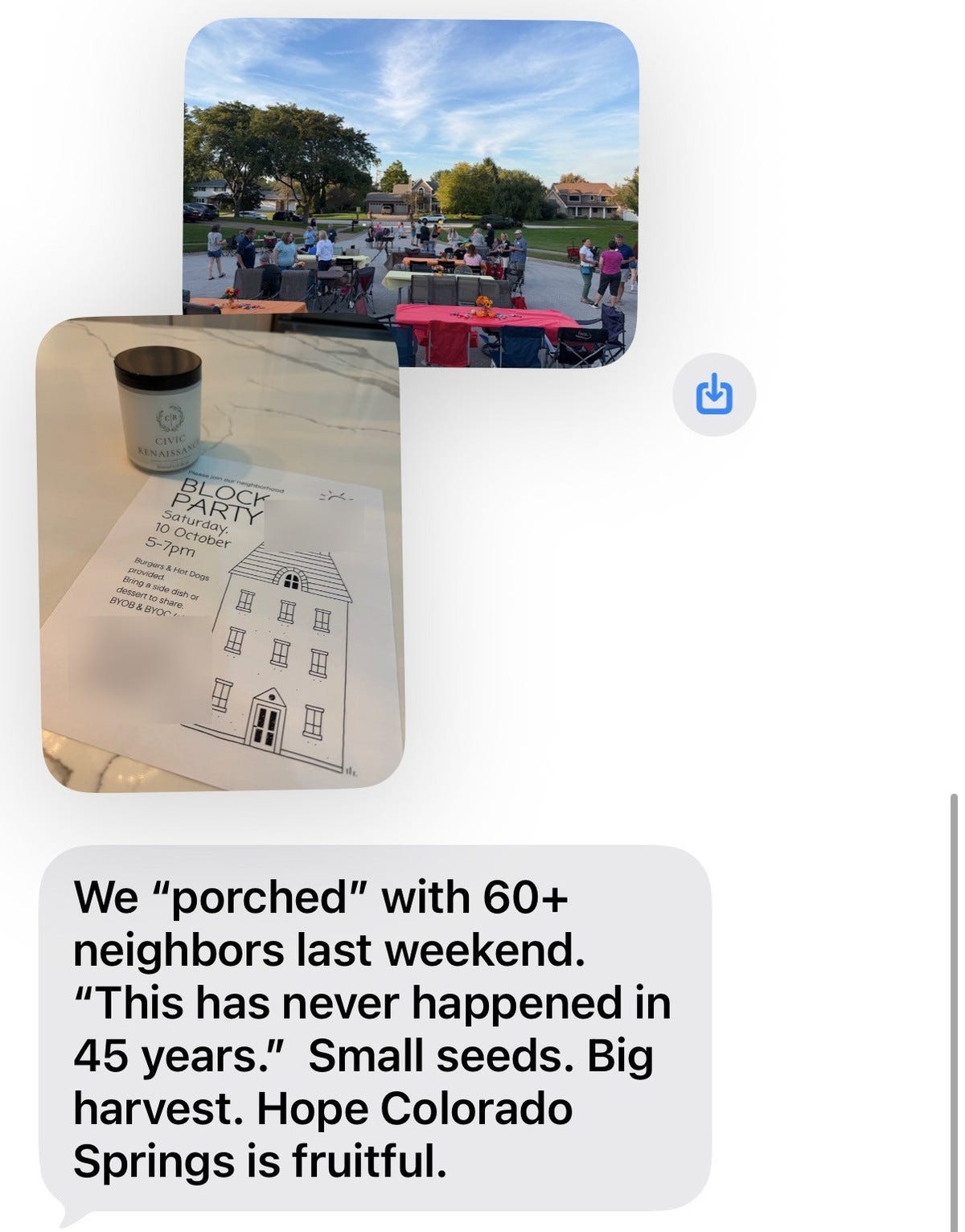
“We porched with 60+ neighbors last weekend. This has never happened in 45 years. Small seeds. Big harvest.”
Sixty neighbors. Forty-five years. One flyer, a few folding tables, and one neighbor willing to go first.
I love hearing from porchers across the country who are joining this quiet, subversive rebellion against our atomized and divided status quo. Notes like this give me such hope, because they prove something I believe deeply: we each have more power than we realize. We cannot control what happens tonight. But we can set the table.
Have a porching story? Share it in the comments below. I’d love to hear it, and to share it to encourage others.
Will you porch with us?
The best antidote I know to a hard election week is a gathering. That’s why I created the Porching Challenge: to make it easy for anyone to pick up the book and build right where they are. Choose your place. Invite your people, especially someone who sees the world differently. Decide who hosts next.
Nearly 40 porchers across nine states, Canada, and Australia have already said yes. See them on the Porching Map, and join the Porching Challenge here. The free toolkit gifts you the introduction and first two chapters for your first three gatherings. Reading as a group? Porch Packs of 10 or more ship free.
For this week, one question: What is one relationship you want to take better care of, whatever the results?
With gratitude,
Lexi
P.S. Do you know a journalist, editor, producer, or podcast host interested in how Americans rebuild trust across deep disagreement? I’d be grateful for an introduction.