
Democracy Is Not a Spectator Sport
The demands of citizenship in a divided time, as tested in the Texas legislature

Gracious reader,
The central, timeless question of democracy is this: when it comes to social flourishing, which comes first, good citizens or good leaders?
For those of us who care about healthier public life, this is not an abstract philosophical question. It is a practical question about responsibility. Where should we focus our energy? On shaping better leaders, or on forming better citizens? Who is responsible for the health of a democracy?
Last week, a member-led invitation to read my book, The Soul of Civility, went out to all 180 members of the Texas State Legislature. That invitation goes straight to the heart of this timeless question.
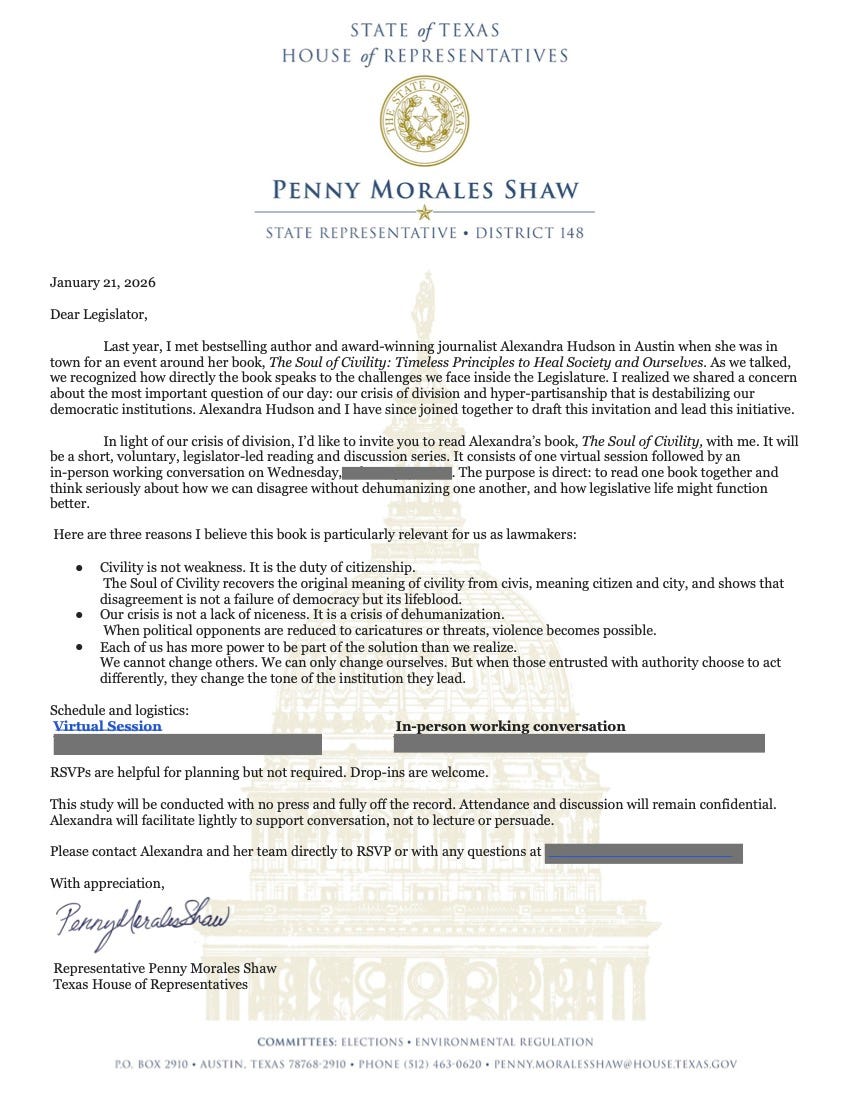
As I shared last week, this effort is an experiment at the level of leadership. In our current moment, civility is often treated as a liability rather than a strength. Moderation is suspect. Bipartisanship is a dirty word. Leaders are frequently punished, primaried, or publicly attacked for being seen as too measured or too restrained toward their opponents.
The question, then, is a practical one. When the usual risks are removed, when there is no public signaling, no performative cost, and no threat of being labeled too soft, will leaders still choose to show up this week for a serious conversation about governing across division and caring for the long-term health of the institutions they serve, under conditions of anonymity?
That is the leadership question this effort is designed to test.
We are also running an experiment of citizenship. It is often said that we get the leaders we deserve. Right now, the incentives in our public life are badly skewed. Leaders are often rewarded for being vicious and graceless toward their opponents. Citizens reward that behavior with attention, applause, and loyalty. Meanwhile, restraint, seriousness, and good conduct are ignored or dismissed as weakness. When this is the incentive structure, we should not be surprised by the results.
What is our role as citizens in reversing those incentives? If the citizen is prior to the state, as democracy promises it is, then we have a greater responsibility than we often realize.
What does it look like for citizens to take responsibility for the culture of their democracy, not only by voting or protesting, but by shaping the incentives their leaders respond to?
This week, I learned something that gave me real hope.
A group of Civic Renaissance student ambassadors in Texas, organized by one of our ambassadors, spent this week and last calling legislative offices. Not to demand. Not to shame. Simply to thank leaders for their service, to acknowledge the cost of public office, and to say that as Texans, they care about the health of their institutions and hope their representatives will participate in this conversation.
This is the kind of citizen action that matters. It is quiet. It is serious. It treats public servants as human beings with agency rather than avatars in a culture war.
Will it work? Will it encourage representatives in Texas to show up this week to our virtual meeting, and to our in-person one next week?
We do not yet know. But we are giving it our best shot.
So what comes first, good leaders or good citizens?
The answer is both.
Alexis de Tocqueville, in Democracy in America, wrote, “America is great because she is good. If America ceases to be good, America will cease to be great.” The line is often repeated casually, but its meaning is demanding.
For American self-government to endure, Americans need both good leaders and good citizens. They are mutually reinforcing.
Leaders shape institutions, incentives, and norms. Citizens shape what is rewarded, tolerated, and ultimately sustained. Over time, each forms the other. When either side abdicates responsibility, the whole system degrades.
This is the challenge we face right now, not only nationally, but locally and institutionally.
In Texas, this leadership study is an attempt to bring forth what is best in both leaders and citizens.
It tests whether leaders will choose seriousness, humanity across difference, and the restraint that allows institutions to flourish, and whether citizens will signal that these qualities still matter and are worth supporting.
That is how renewal happens. Not through slogans or spectacle, but through shared responsibility, taken seriously, on both sides of public life.
If you are a Texas resident reading this, you have a role to play in this experiment.
Call your representative’s office. Introduce yourself as a constituent. Thank them for serving. Tell them you care about the long-term health of Texas’s institutions and hope they will take part in this leadership study.
Our voices as citizens matter. We are not spectators to public life. We help shape what is rewarded and what endures.
Focus on what you can control. That is where renewal begins.
If these questions matter to you, I invite you to join the conversation by sharing this post with others who care about the health of our public life.
Invitation: The Forgotten Virtue of Moderation
A live dialogue with Alexandra Hudson and Thomas Chatterton Williams
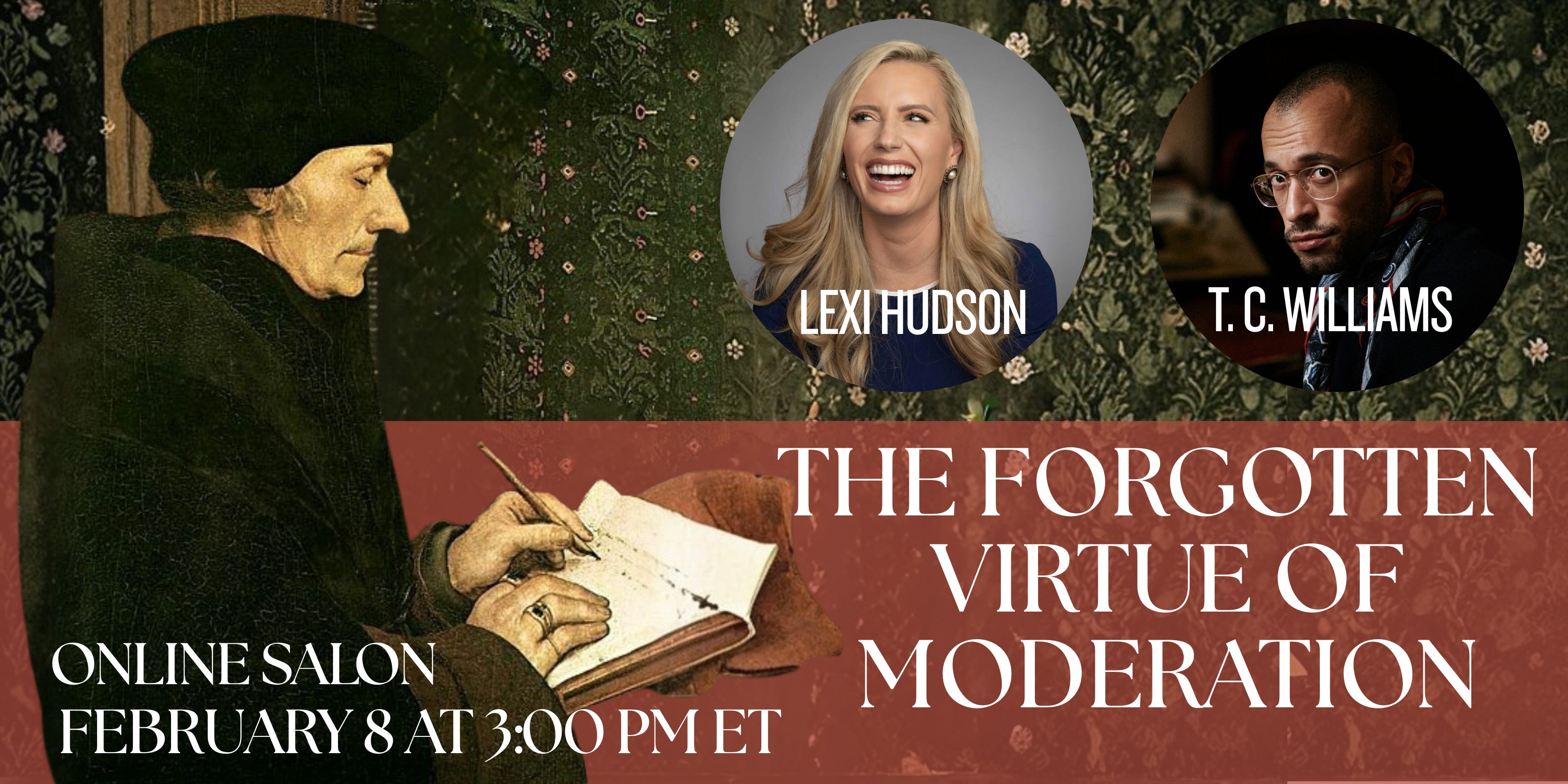
In an age shaped by outrage, certainty, and faction, moderation has become suspect. Those who refuse to sort neatly into camps are often dismissed as weak, naïve, or uncommitted. And yet, across history, the thinkers who most enlarged human understanding were rarely loyal to a side. They were loyal to truth.
This evening is a live dialogue between Alexandra Hudson and Thomas Chatterton Williams on the recovery of moderation as a serious intellectual posture, and on the examined life as its necessary foundation.
In the news
“Author launches national civic renaissance tour in Shelbyville,” The Shelbyville News
The Shelbyville effort is being led locally by Pastor Ralph Botte of First Christian Church of Shelbyville, who invited Hudson to help launch a community-wide initiative inspired by her book.
“When I read The Soul of Civility, it gave language to a problem I was seeing every day in Shelbyville,” Botte said. “People wanted to engage across differences without tearing relationships apart, but we didn’t have a shared framework for doing that. The book clarified what was missing: a way to practice civility that goes beyond surface politeness and is grounded in human dignity. That’s what led me to reach out to Alexandra. As we began sharing the book locally, people recognized themselves in it and wanted to take responsibility for living these ideas together.”
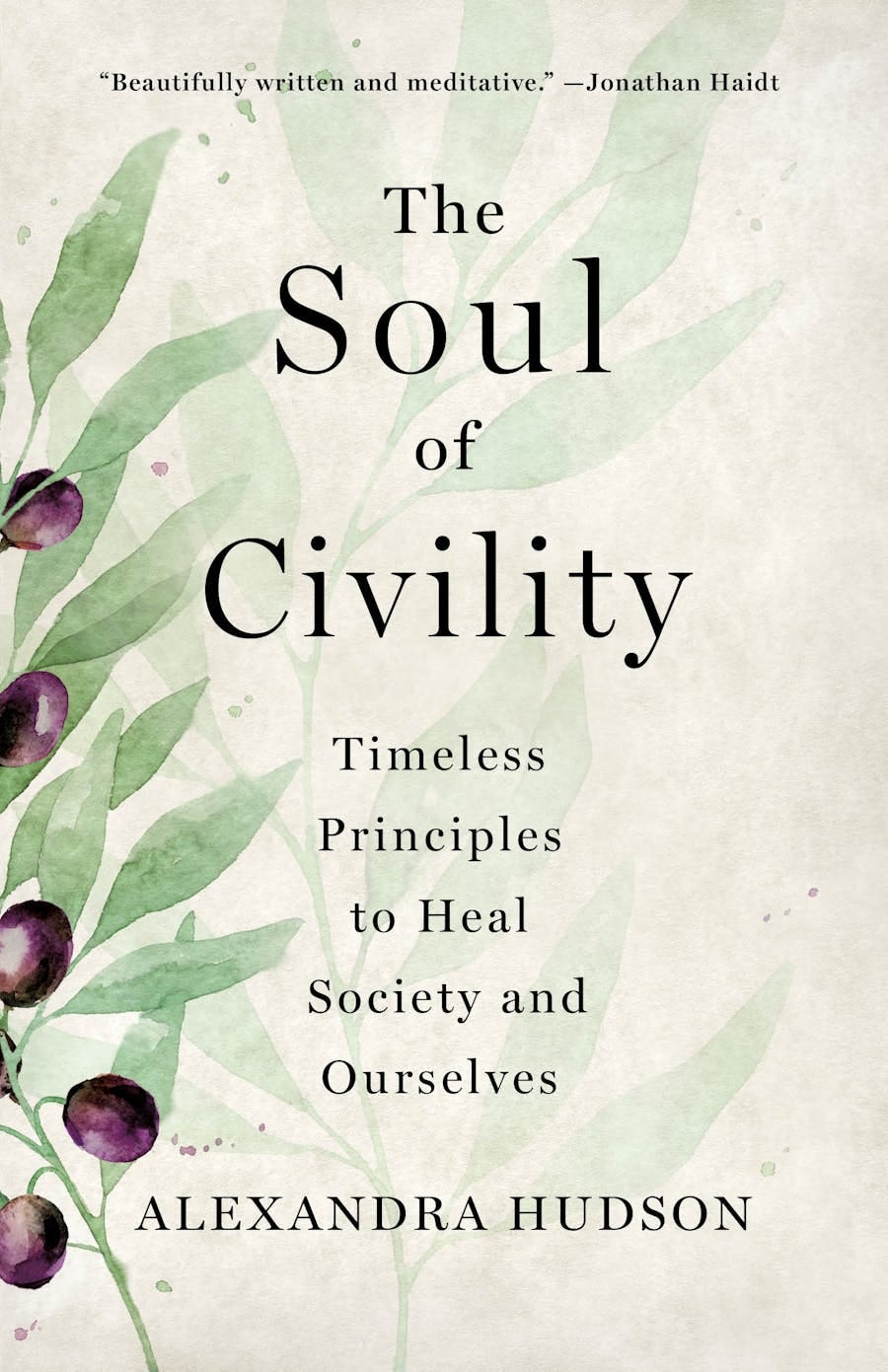
The Civic Renaissance Tour represents the next phase of Hudson’s work, building directly on the impact of The Soul of Civility. Since its release in 2023, the book has been taken up by community leaders, universities, and bipartisan legislative groups across the United States and abroad as a practical framework for engaging disagreement without dehumanization and for reclaiming responsibility at the local level. Rather than remaining a theoretical work, the book has repeatedly served as a catalyst for concrete civic initiatives. In an age marked by polarization and distrust, The Soul of Civility asks a central question: how can people flourish across difference?
Following the book’s publication, Hudson, often traveling with her husband and three small children, visited 136 cities across five countries. She spoke in venues ranging from local libraries and churches to Stanford University, Yale Law School, the Canadian Parliament, and the UK House of Lords. In city after city, the book sparked not only conversation, but sustained local action.
“The Civic Renaissance Tour grew out of listening,” Hudson said. “Everywhere I went, leaders were asking how to live these ideas together, not just talk about them. I realized my role was not to visit and lead every community, but to help local leaders build the capacity, relationships, and support they need to carry this work forward every day.”
The Shelbyville launch follows Hudson’s demonstrated framework for community renewal, a four-phase process that moves communities from shared understanding to sustained local practice. The effort begins with residents reading The Soul of Civility together, followed by Hudson’s visit for a public event and leaders’ roundtable. From there, local leaders across sectors will take responsibility for carrying the work forward in daily civic life, with the long-term goal of Shelbyville serving as a regional hub for civic renewal.
The Shelbyville engagement will begin with a community-wide public event on Thursday, January 29, at 7:00 p.m. at First Christian Church of Shelbyville. The following morning, Friday, January 30 at 9:00 a.m., Hudson and Botte will convene a leaders’ roundtable. During the roundtable, a select group of Shelbyville leaders will work together with Hudson to develop a practical action plan for implementing the book’s ideas and fostering long-term civic renewal in the community.
Hudson’s work with Shelbyville follows a demonstrated and repeatable pattern.
In Carmel, Indiana, City Councilor Jeff Worrell contacted Hudson after reading The Soul of Civility to explore how its ideas could be embedded locally. That effort culminated in the Carmel Civility Summit, which convened more than 100 mayors, city council members, commissioners, and civic leaders from 17 states and Canada. “The Soul of Civility was a roadmap that led me to invite Alexandra to speak and launch a civility effort in Carmel,” Worrell said. Former Indiana Governor Mitch Daniels and Hudson opened the summit with a fireside conversation on civility and leadership. “You’ve only begun to hear from this amazing young woman,” Daniels said.
In Zionsville, former Deputy Mayor Kate Swanson partnered with the Mayor’s Youth Advisory Council to integrate The Soul of Civility into the council’s core curriculum, grounding civic formation in a shared moral framework. The council then convened a public community discussion with Alexandra Hudson at the Hussey-Mayfield Memorial Public Library, drawing a standing-room-only audience and signaling broad public engagement across generations.
“Every person, and especially every young person, in America needs to read The Soul of Civility,” Swanson said.
In Muncie, The Soul of Civility was chosen as a citywide community read, anchoring a shared civic conversation across residents, institutions, and local leaders. State Rep. Elizabeth Rowray partnered with the Muncie Chamber of Commerce to invite Alexandra Hudson to keynote their Christmas banquet, where every attendee received a copy of the book as a call to carry the work into their own civic and professional lives.
Communities across Indiana, including Fishers, Valparaiso, South Bend, Evansville, New Albany, and Salem, are now implementing similar initiatives inspired by Hudson’s work.
Nationally, The Soul of Civility is informing freshman orientation programs at Ivy League universities and is being read in bipartisan book clubs within polarized state legislatures. The book has earned praise from leaders and public intellectuals across the political spectrum, including Francis Fukuyama and Jonathan Haidt.
The Civic Renaissance Tour formalizes this growing momentum by offering communities a structured pathway to move from shared ideas to sustained local practice. Additional tour stops include Colorado Springs, Colorado; Urbandale, Iowa; Sacramento, California; Austin, Texas; Pittsburgh, Pennsylvania; Toronto, Canada; and London, England, with more locations to be announced.
“My vision is to help unlock an era of human flourishing in our country,” Hudson, who lives in Indianapolis, said. “That work begins when people stop waiting for rescue and start taking responsibility for the communities they are shaping together. We each have way more power than we realize to be part of the solution.”
She continued, “Ralph, First Christian Church of Shelbyville, and the greater Shelbyville community are showing what that looks like in practice. I am honored to partner with the leaders of Shelbyville in this work.”
As the kickoff city of the Civic Renaissance initiative, Shelbyville is helping shape and refine a new model of community renewal rooted in Alexandra Hudson’s The Soul of Civility. The city is piloting the framework as it moves from idea to practice, generating lessons that other communities can adapt to their own contexts. By launching the Civic Renaissance Tour in Shelbyville, local leaders are contributing to an emerging national effort to strengthen civic life by investing in their own capacity to lead and flourish.
Year Ago on Civic Renaissance:
When does an intellectual failing become a moral one? Bonhoeffer's theory of stupidity
Thank you for being part of our Civic Renaissance community!
The reframing of citizen responsibility as shaping leader incentives is really sharp. The student ambassadors calling to thank representatives shifts the whole dynamic from demanding to supporting, which feels way more sustainable longterm. The mutual reinforcement point between leaders and citizens lands hard too, since degradation on either side drags the whole system down. Been wondering lately how local initiatives like this could scale without losing the nuance thatmakes them work.